Ch. 3 - Derivatives
Briggs - Calculus: Early Transcendentals 3rd Edition
Briggs3rd EditionCalculus: Early TranscendentalsISBN: 9780136847243Not the one you use?Change textbook
Chapter 3, Problem 3.10.76

67–78. Derivatives of inverse functions Consider the following functions (on the given interval, if specified). Find the derivative of the inverse function.


f(x) = x^2/3, for x>0

Verified step by step guidance
1
First, understand that if y = f(x) is a function, then its inverse function is denoted as x = f^(-1)(y). We need to find the derivative of this inverse function.
Given the function f(x) = x^(2/3), we need to find the inverse function. To do this, set y = x^(2/3) and solve for x in terms of y.
Raise both sides to the power of 3/2 to solve for x: x = y^(3/2). This gives us the inverse function f^(-1)(y) = y^(3/2).
To find the derivative of the inverse function, use the formula: (d/dx)[f^(-1)(y)] = 1 / (f'(f^(-1)(y))).
Calculate f'(x) for the original function: f'(x) = (2/3)x^(-1/3). Substitute f^(-1)(y) = y^(3/2) into this derivative to find the derivative of the inverse function.

Verified video answer for a similar problem:

This video solution was recommended by our tutors as helpful for the problem above.
Video duration:
4m
Was this helpful?

Key Concepts

Here are the essential concepts you must grasp in order to answer the question correctly.

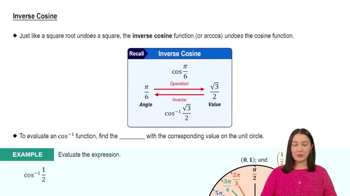
Inverse Functions

An inverse function reverses the effect of the original function. If f(x) takes an input x and produces an output y, then the inverse function f⁻¹(y) takes y back to x. For a function to have an inverse, it must be one-to-one, meaning it passes the horizontal line test, ensuring each output corresponds to exactly one input.
Recommended video:
4:49
Inverse Cosine

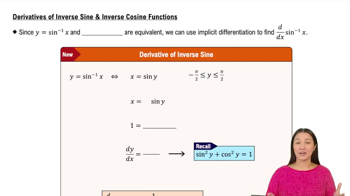
Derivative of Inverse Functions

The derivative of an inverse function can be found using the formula (f⁻¹)'(y) = 1 / f'(x), where y = f(x). This relationship arises from the chain rule, which states that the derivative of the composition of functions is the product of their derivatives. It allows us to compute the slope of the tangent line to the inverse function at a given point.
Recommended video:
07:26
Derivatives of Inverse Sine & Inverse Cosine

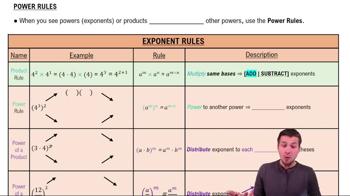
Power Rule for Derivatives

The power rule is a fundamental technique in calculus for finding the derivative of functions of the form f(x) = x^n, where n is a real number. According to the power rule, the derivative f'(x) = n * x^(n-1). This rule simplifies the process of differentiation, making it easier to compute derivatives of polynomial functions, including those involved in finding derivatives of inverse functions.
Recommended video: