

Ch. 6 - Applications of Integration
Briggs - Calculus: Early Transcendentals 3rd Edition
Briggs3rd EditionCalculus: Early TranscendentalsISBN: 9780136847243Not the one you use?Change textbook
Chapter 6, Problem 6.1.24b

Cycling distance A cyclist rides down a long straight road with a velocity (in m/min) given by v(t) = 400−20t, for 0≤t≤10, where t is measured in minutes.


b. How far does the cyclist travel in the first 10 min?

Verified step by step guidance
1
Identify the velocity function given: \(v(t) = 400 - 20t\), where \(t\) is in minutes and \(v(t)\) is in meters per minute.
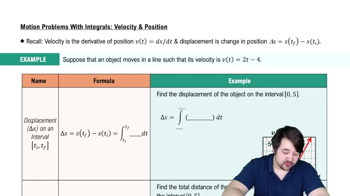
Recall that the distance traveled over a time interval can be found by integrating the velocity function over that interval. So, the distance \(D\) traveled from \(t=0\) to \(t=10\) is given by the definite integral \(D = \int_0^{10} v(t) \, dt\).
Set up the integral explicitly: \(D = \int_0^{10} (400 - 20t) \, dt\).
Integrate the function term-by-term: the integral of \(400\) with respect to \(t\) is \$400t\(, and the integral of \)-20t\( with respect to \)t\( is \)-10t^2$.
Evaluate the resulting expression \(400t - 10t^2\) at the upper limit \(t=10\) and subtract the value at the lower limit \(t=0\) to find the total distance traveled.

Verified video answer for a similar problem:

This video solution was recommended by our tutors as helpful for the problem above.
Video duration:
2m
Was this helpful?

Key Concepts

Here are the essential concepts you must grasp in order to answer the question correctly.

Velocity as a Function of Time

Velocity describes the rate of change of position with respect to time. In this problem, velocity is given as a function v(t) = 400 - 20t, which means the cyclist's speed changes linearly over time from 400 m/min to 200 m/min during the first 10 minutes.
Recommended video:
10:17
Using The Velocity Function

Definite Integral for Displacement

The total distance traveled over a time interval can be found by integrating the velocity function over that interval. The definite integral of v(t) from t=0 to t=10 gives the net displacement, representing how far the cyclist has traveled in those 10 minutes.
Recommended video:
05:43
Definition of the Definite Integral

Limits of Integration and Time Interval

The problem specifies the time interval 0 ≤ t ≤ 10 minutes. Setting the correct limits of integration ensures the calculation covers the entire duration of interest, capturing the cyclist's motion from start to 10 minutes exactly.
Recommended video:
11:11
Improper Integrals: Infinite Intervals
Related Practice
Textbook Question

6–8. Let R be the region bounded by the curves y = 2−√x,y=2, and x=4 in the first quadrant.

Suppose the shell method is used to determine the volume of the solid generated by revolving R about the line x=4.


b. What is the height of a cylindrical shell at a point x in [0, 4]?

88
views
Textbook Question

For the given regions R₁ and R₂, complete the following steps.


b. Find the area of region R₂ using geometry and the answer to part (a).


R₁is the region in the first quadrant bounded by the line x=1 and the curve y=6x(2−x^2)^2; R₂ is the region in the first quadrant bounded the curve y=6x(2−x^2)^2and the line y=6x.

40
views
Textbook Question

Variable gravity At Earth’s surface, the acceleration due to gravity is approximately g=9.8 m/s² (with local variations). However, the acceleration decreases with distance from the surface according to Newton’s law of gravitation. At a distance of y meters from Earth’s surface, the acceleration is given by a(y) = - g / (1+y/R)², where R=6.4×10⁶ m is the radius of Earth.


b. Use the Chain Rule to show that dv/dt = 1/2 d/dy(v²).

69
views
Textbook Question

Determine whether the following statements are true and give an explanation or counterexample.


b. The area of the region between y=sin x and y=cos x on the interval [0,π/2] is ∫π/20(cosx−sinx)dx.

45
views
Textbook Question

40–43. Population growth


Starting with an initial value of P(0)=55, the population of a prairie dog community grows at a rate of P′(t)=20−t/5 (prairie dogs/month), for 0≤t≤200, where t is measured in months.


b. Find the population P(t), for 0≤t≤200.

22
views
Textbook Question

Compressing and stretching a spring Suppose a force of 15 N is required to stretch and hold a spring 0.25 m from its equilibrium position.

b. How much work is required to compress the spring 0.2 m from its equilibrium position?

62
views