Ch. 3 - Derivatives
Hass - Thomas' Calculus 15th Edition
Hass15th EditionThomas' CalculusISBN: 9780137616077Not the one you use?Change textbook
Chapter 3, Problem 3.3.57

Find the value of a that makes the following function differentiable for all x-values.


g(x) = { ax, if x < 0
x² − 3x, if x ≥ 0

Verified step by step guidance
1
To ensure the function g(x) is differentiable at x = 0, it must be continuous at x = 0. This means the left-hand limit as x approaches 0 from the negative side must equal the right-hand limit as x approaches 0 from the positive side.
Calculate the left-hand limit of g(x) as x approaches 0 from the negative side: lim(x → 0⁻) ax = a * 0 = 0.
Calculate the right-hand limit of g(x) as x approaches 0 from the positive side: lim(x → 0⁺) (x² - 3x) = 0² - 3*0 = 0.
Since both limits are equal, the function is continuous at x = 0. Now, ensure the derivatives from both sides are equal at x = 0 for differentiability.
Find the derivative of g(x) for x < 0, which is g'(x) = a. Find the derivative of g(x) for x ≥ 0, which is g'(x) = 2x - 3. Set these equal at x = 0: a = 2*0 - 3 = -3. Therefore, a must be -3 for differentiability.

Verified video answer for a similar problem:

This video solution was recommended by our tutors as helpful for the problem above.
Video duration:
3m
Was this helpful?

Key Concepts

Here are the essential concepts you must grasp in order to answer the question correctly.

Differentiability

A function is differentiable at a point if it has a defined derivative at that point. This means that the function must be continuous at that point, and the left-hand and right-hand derivatives must be equal. In this case, we need to ensure that the function g(x) is differentiable at x = 0, where the definition of the function changes.
Recommended video:
05:53
Finding Differentials

Continuity

A function is continuous at a point if the limit of the function as it approaches that point from both sides equals the function's value at that point. For g(x) to be differentiable at x = 0, it must first be continuous there. This requires that the left-hand limit (as x approaches 0 from the left) equals the right-hand limit (as x approaches 0 from the right) and that both equal g(0).
Recommended video:
05:34
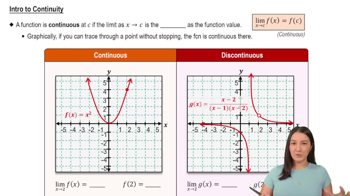
Intro to Continuity

Piecewise Functions

A piecewise function is defined by different expressions based on the input value. In this case, g(x) has two pieces: ax for x < 0 and x² - 3x for x ≥ 0. To analyze differentiability, we must examine the behavior of both pieces at the point where they meet (x = 0) and ensure that they connect smoothly without any jumps or breaks.
Recommended video:
05:36
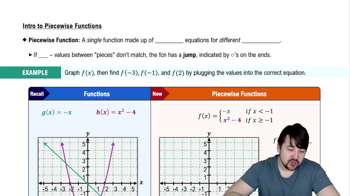
Piecewise Functions