Ch. 2 - Limits
Briggs - Calculus: Early Transcendentals 3rd Edition
Briggs3rd EditionCalculus: Early TranscendentalsISBN: 9780136847243Not the one you use?Change textbook
Chapter 2, Problem 12b

Given the function f(x)=16x2+64xf\(\left\)(x\(\right\))=-16x^2+64x, complete the following. <IMAGE>
Make a conjecture about the value of the limit of the slopes of the secant lines that pass through (x,f(x))\(\left\)(x,f\(\left\)(x\(\right\))\(\right\)) and (2,f(2))\(\left\)(2,f\(\left\)(2\(\right\))\(\right\)) as xx approaches 22.

Verified step by step guidance
1
First, understand that the slope of the secant line between two points (x, f(x)) and (2, f(2)) on the curve is given by the difference quotient: \( m_{sec} = \frac{f(x) - f(2)}{x - 2} \).
Calculate \( f(2) \) by substituting \( x = 2 \) into the function \( f(x) = -16x^2 + 64x \). This will give you the y-coordinate of the point (2, f(2)).
Substitute \( f(x) = -16x^2 + 64x \) and \( f(2) \) into the difference quotient formula: \( m_{sec} = \frac{-16x^2 + 64x - f(2)}{x - 2} \).
Simplify the expression for \( m_{sec} \) by performing polynomial division or factoring, if possible, to eliminate the \( x - 2 \) in the denominator.
Finally, make a conjecture about the limit of \( m_{sec} \) as \( x \) approaches 2. This involves evaluating the simplified expression for \( m_{sec} \) as \( x \to 2 \), which will give you the slope of the tangent line at \( x = 2 \).

Verified video answer for a similar problem:

This video solution was recommended by our tutors as helpful for the problem above.
Video duration:
8m
Was this helpful?

Key Concepts

Here are the essential concepts you must grasp in order to answer the question correctly.

Secant Lines

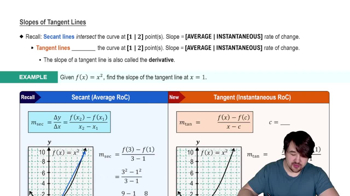
Secant lines are straight lines that connect two points on a curve. In calculus, they are used to approximate the slope of the curve between those two points. The slope of a secant line is calculated as the change in the function's value divided by the change in the x-values, which is represented mathematically as (f(b) - f(a)) / (b - a). As the two points get closer together, the secant line approaches the tangent line at a point.
Recommended video:
05:13
Slopes of Tangent Lines

Limits

A limit is a fundamental concept in calculus that describes the behavior of a function as its input approaches a certain value. It helps in understanding the function's behavior near points where it may not be explicitly defined. In this context, the limit of the slopes of the secant lines as x approaches 2 is crucial for determining the instantaneous rate of change of the function at that point, which is the derivative.
Recommended video:
05:50
One-Sided Limits

Derivatives

The derivative of a function at a point represents the instantaneous rate of change of the function with respect to its variable. It is defined as the limit of the slope of the secant lines as the two points converge to that point. In this case, finding the limit of the slopes of the secant lines as x approaches 2 will yield the derivative of the function f(x) at x = 2, providing insight into the function's behavior at that specific point.
Recommended video:
05:44
Derivatives