Ch. 1 - Functions
Briggs - Calculus: Early Transcendentals 3rd Edition
Briggs3rd EditionCalculus: Early TranscendentalsISBN: 9780136847243Not the one you use?Change textbook
Chapter 1, Problem 78

Evaluating inverse trigonometric functions Without using a calculator, evaluate the following expressions.
csc1(1)\(\csc\)^{-1}\(\left\)(-1\(\right\))

Verified step by step guidance
1
Understand that \( \csc^{-1}(x) \) is the inverse cosecant function, which gives the angle \( \theta \) such that \( \csc(\theta) = x \).
Recall that \( \csc(\theta) = \frac{1}{\sin(\theta)} \). Therefore, \( \csc^{-1}(-1) \) means we are looking for an angle \( \theta \) where \( \sin(\theta) = -1 \).
The sine function \( \sin(\theta) \) equals \(-1\) at specific angles. Consider the unit circle: \( \sin(\theta) = -1 \) at \( \theta = \frac{3\pi}{2} \) (or \( 270^\circ \)).
Verify that \( \theta = \frac{3\pi}{2} \) is within the range of the inverse cosecant function. The principal range for \( \csc^{-1}(x) \) is \([-\frac{\pi}{2}, \frac{\pi}{2}] \) excluding \( 0 \), but for negative values, we consider angles in the third and fourth quadrants.
Conclude that the angle \( \theta = \frac{3\pi}{2} \) satisfies the condition \( \csc(\theta) = -1 \), and thus \( \csc^{-1}(-1) = \frac{3\pi}{2} \).

Verified video answer for a similar problem:

This video solution was recommended by our tutors as helpful for the problem above.
Video duration:
2m
Was this helpful?

Key Concepts

Here are the essential concepts you must grasp in order to answer the question correctly.

Inverse Trigonometric Functions

Inverse trigonometric functions, such as arcsin, arccos, and arccsc, are the functions that reverse the action of the corresponding trigonometric functions. For example, if y = sin(x), then x = arcsin(y). These functions are defined for specific ranges to ensure they are one-to-one, allowing for unique outputs for each input.
Recommended video:
06:35
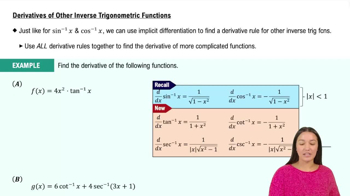
Derivatives of Other Inverse Trigonometric Functions

Cosecant Function

The cosecant function, denoted as csc(x), is the reciprocal of the sine function, defined as csc(x) = 1/sin(x). It is important to note that csc(x) is undefined where sin(x) = 0. The cosecant function is particularly relevant when evaluating expressions involving inverse cosecant, such as csc^{-1}(-1).
Recommended video:
6:22
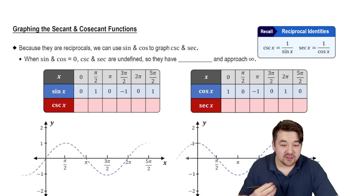
Graphs of Secant and Cosecant Functions

Range of Inverse Cosecant

The range of the inverse cosecant function, csc^{-1}(x), is limited to the intervals (-∞, -1] and [1, ∞). This means that csc^{-1}(x) can only yield values outside the interval (-1, 1), which is crucial when evaluating expressions like csc^{-1}(-1), as it indicates the specific angle whose cosecant is -1.
Recommended video:
4:49
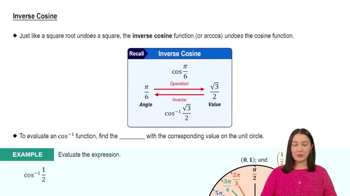
Inverse Cosine