Ch. 1 - Functions
Briggs - Calculus: Early Transcendentals 3rd Edition
Briggs3rd EditionCalculus: Early TranscendentalsISBN: 9780136847243Not the one you use?Change textbook
Chapter 1, Problem 80

Evaluating inverse trigonometric functions Without using a calculator, evaluate the following expressions.
tan1(tan(3π4))\(\tan\)^{-1}\(\left\)(\(\tan\[\left\)(\(\frac{3\pi}{4}\]\right\))\(\right\))

Verified step by step guidance
1
Understand the problem: We need to evaluate \( \tan^{-1}(\tan(\frac{3\pi}{4})) \). This involves understanding the behavior of the tangent function and its inverse.
Recall the range of \( \tan^{-1}(x) \), which is \( (-\frac{\pi}{2}, \frac{\pi}{2}) \). The inverse tangent function will return an angle within this range.
Evaluate \( \tan(\frac{3\pi}{4}) \). The angle \( \frac{3\pi}{4} \) is in the second quadrant, where the tangent function is negative. Specifically, \( \tan(\frac{3\pi}{4}) = -1 \).
Now, find \( \tan^{-1}(-1) \). Since \( \tan^{-1}(x) \) returns an angle in \( (-\frac{\pi}{2}, \frac{\pi}{2}) \), we need to find an angle in this range whose tangent is \(-1\).
The angle that satisfies \( \tan(\theta) = -1 \) within the range \( (-\frac{\pi}{2}, \frac{\pi}{2}) \) is \( -\frac{\pi}{4} \). Therefore, \( \tan^{-1}(\tan(\frac{3\pi}{4})) = -\frac{\pi}{4} \).

Verified video answer for a similar problem:

This video solution was recommended by our tutors as helpful for the problem above.
Video duration:
4m
Was this helpful?

Key Concepts

Here are the essential concepts you must grasp in order to answer the question correctly.

Inverse Trigonometric Functions

Inverse trigonometric functions, such as an^{-1} (arctan), are used to find the angle whose tangent is a given number. These functions are defined over specific ranges to ensure they are one-to-one, allowing for unique outputs. Understanding their properties and ranges is crucial for evaluating expressions involving these functions.
Recommended video:
06:35
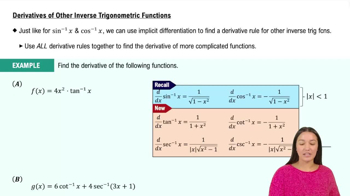
Derivatives of Other Inverse Trigonometric Functions

Periodic Functions

Trigonometric functions like sine, cosine, and tangent are periodic, meaning they repeat their values in regular intervals. For example, the tangent function has a period of an(x + π) = tan(x). This periodicity is essential when evaluating expressions involving angles that exceed the standard range of the inverse functions.
Recommended video:
6:22
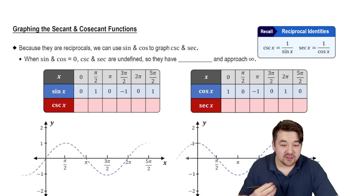
Graphs of Secant and Cosecant Functions

Angle Reduction

Angle reduction involves simplifying angles to fall within a specific range, typically between 0 and 2π for trigonometric functions. For instance, rac{3 ext{π}}{4} can be analyzed in terms of its reference angle in the second quadrant. This technique is vital for accurately evaluating trigonometric expressions and their inverses.
Recommended video:
8:22
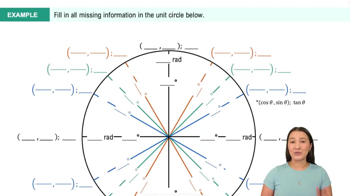
Trig Values in Quadrants II, III, & IV Example 2