Ch. 2 - Limits
Briggs - Calculus: Early Transcendentals 3rd Edition
Briggs3rd EditionCalculus: Early TranscendentalsISBN: 9780136847243Not the one you use?Change textbook
Chapter 2, Problem 6

Determine the following limits at infinity.


lim x→−∞ x^−11

Verified step by step guidance
1
Identify the function: The function given is \(f(x) = x^{-11}\).
Understand the behavior of the function: As \(x\) approaches \(-\infty\), the base \(x\) becomes a very large negative number.
Consider the exponent: The exponent is \(-11\), which is a negative odd integer.
Apply the rule for negative exponents: \(x^{-11} = \frac{1}{x^{11}}\). This means the function is the reciprocal of \(x^{11}\).
Analyze the limit: As \(x\) approaches \(-\infty\), \(x^{11}\) becomes a very large positive number, so \(\frac{1}{x^{11}}\) approaches \(0\).

Verified video answer for a similar problem:

This video solution was recommended by our tutors as helpful for the problem above.
Video duration:
3m

Key Concepts

Here are the essential concepts you must grasp in order to answer the question correctly.

Limits at Infinity

Limits at infinity refer to the behavior of a function as the input approaches positive or negative infinity. This concept helps in understanding how functions behave in extreme cases, allowing us to determine whether they approach a specific value, diverge, or oscillate. Evaluating limits at infinity is crucial for analyzing horizontal asymptotes and the end behavior of functions.
Recommended video:
05:50
One-Sided Limits

Polynomial Functions

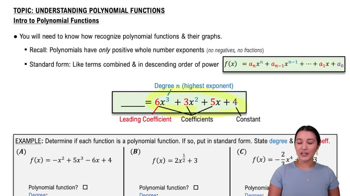
Polynomial functions are expressions that consist of variables raised to non-negative integer powers, combined using addition, subtraction, and multiplication. The degree of the polynomial, determined by the highest power of the variable, significantly influences its behavior as x approaches infinity or negative infinity. Understanding the properties of polynomial functions is essential for evaluating their limits.
Recommended video:
6:04
Introduction to Polynomial Functions

Negative Exponents

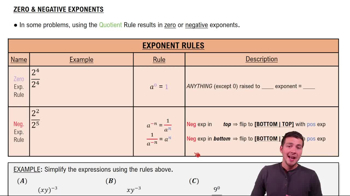
Negative exponents indicate the reciprocal of the base raised to the corresponding positive exponent. For example, x^−n is equivalent to 1/x^n. This concept is important when analyzing limits involving negative exponents, as it can transform the expression into a more manageable form, particularly when considering limits at infinity.
Recommended video:
6:37
Zero and Negative Rules