
Textbook Question
Zero net area Consider the function ƒ(𝓍) = 𝓍² ― 4𝓍 .
(a) Graph ƒ on the interval 𝓍 ≥ 0.
61
views

 Verified step by step guidance
 06:29
06:29
 10:17 06:29
Zero net area Consider the function ƒ(𝓍) = 𝓍² ― 4𝓍 .
(a) Graph ƒ on the interval 𝓍 ≥ 0.
Explain why or why not Determine whether the following statements are true and give an explanation or counterexample. Assume ƒ, ƒ', and ƒ'' are continuous functions for all real numbers.
(a) ∫ ƒ(𝓍) ƒ'(𝓍) d𝓍 = ½ (ƒ(𝓍))² + C.
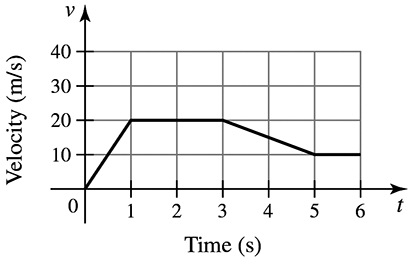
The velocity in ft/s of an object moving along a line is given by v = ƒ(t) on the interval 0 ≤ t ≤ 6 (see figure), where t is measured in seconds.
(a) Divide the interval [0,6] into n = 3 subintervals, [0,2] , [2,4] and [4,6]. On each subinterval, assume the object moves at a constant velocity equal to the value of v evaluated at the right endpoint of the subinterval, and use these approximations to estimate the displacement of the object on [0,6] (see part (a) of the figure)
Sigma notation Evaluate the following expressions.
(a) 10
∑ κ
κ=1
Area functions for constant functions Consider the following functions ƒ and real numbers a (see figure).
(a) Find and graph the area function A(𝓍) = ∫ₐˣ ƒ(t) dt for ƒ.
ƒ(t) = 5 , a = 0
Working with area functions Consider the function ƒ and the points a, b, and c.
(a) Find the area function A (𝓍) = ∫ₐˣ ƒ(t) dt using the Fundamental Theorem.
ƒ(𝓍) = sin 𝓍 ; a = 0 , b = π/2 , c = π