Ch. 5 - Integration
Briggs - Calculus: Early Transcendentals 3rd Edition
Briggs3rd EditionCalculus: Early TranscendentalsISBN: 9780136847243Not the one you use?Change textbook
Chapter 5, Problem 5.1.71d

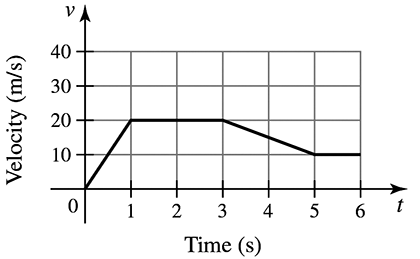
Displacement from a velocity graph Consider the velocity function for an object moving along a line (see figure).
(d) Assuming the velocity remains 10 m/s, for t ≥ 5, find the function that gives the displacement between t = 0 and any time t ≥ 5.
Graph showing velocity in m/s over time in seconds, with a constant velocity of 10 m/s from t=5 seconds onward.

Verified step by step guidance
1
Step 1: Understand the problem. The goal is to find the displacement function for t ≥ 5, given that the velocity remains constant at 10 m/s from t = 5 onward. Displacement is the integral of velocity over time.
Step 2: Recall the formula for displacement. Displacement is given by the definite integral of the velocity function over the interval of interest. For t ≥ 5, the velocity is constant at 10 m/s, so the integral simplifies.
Step 3: Set up the integral. The displacement from t = 0 to any time t ≥ 5 can be expressed as the sum of two parts: (1) the displacement from t = 0 to t = 5, and (2) the displacement from t = 5 to t. For t ≥ 5, the displacement function is: \( s(t) = \int_{0}^{5} v(t) \, dt + \int_{5}^{t} 10 \, dt \).
Step 4: Evaluate the first integral. From the graph, the velocity function \( v(t) \) changes piecewise between t = 0 and t = 5. Break the integral into segments based on the graph: \( \int_{0}^{5} v(t) \, dt = \int_{0}^{1} 10t \, dt + \int_{1}^{3} 20 \, dt + \int_{3}^{5} (-5t + 35) \, dt \).
Step 5: Evaluate the second integral. For t ≥ 5, the velocity is constant at 10 m/s, so \( \int_{5}^{t} 10 \, dt = 10(t - 5) \). Combine the results from Step 4 and Step 5 to express the total displacement function \( s(t) \).

Verified video answer for a similar problem:

This video solution was recommended by our tutors as helpful for the problem above.
Video duration:
4m
Was this helpful?

Key Concepts

Here are the essential concepts you must grasp in order to answer the question correctly.

Velocity and Displacement Relationship

Velocity is the rate of change of displacement with respect to time. To find displacement over a time interval, one can integrate the velocity function. In this case, since the velocity is constant at 10 m/s for t ≥ 5 seconds, the displacement can be calculated as the product of velocity and time.
Recommended video:
06:29
Derivatives Applied To Velocity

Integration in Calculus

Integration is a fundamental concept in calculus used to find the area under a curve, which in the context of velocity, represents displacement. The definite integral of the velocity function from the initial time to a later time gives the total displacement during that interval. For a constant velocity, this simplifies to a straightforward multiplication of velocity and time.
Recommended video:
06:11
Fundamental Theorem of Calculus Part 1

Piecewise Functions

A piecewise function is defined by different expressions based on the input value. In this scenario, the velocity function changes at t = 5 seconds, making it a piecewise function. Understanding how to evaluate such functions is crucial for determining displacement over varying intervals of time.
Recommended video:
05:36
Piecewise Functions
Related Practice
Textbook Question

Left and right Riemann sums Complete the following steps for the given function, interval, and value of n.

f(x) = x + 1 on [0,4]; n = 4

(d) Calculate the left and right Riemann sums.                                                                                                                                                

171
views

Textbook Question

Midpoint Riemann sums Complete the following steps for the given function, interval, and value of n.


ƒ(𝓍) = 2x + 1 on [0,4] ; n = 4


d) Calculate the midpoint Riemann sum.

162
views
Textbook Question

Midpoint Riemann sums Complete the following steps for the given function, interval, and value of n.


{Use of Tech} ƒ(𝓍) = √x on [1,3] ; n = 4


(d) Calculate the midpoint Riemann sum.

134
views
Textbook Question

Use Table 5.6 to evaluate the following definite integrals.                                                                                                                    

 (d) ∫₀^π/¹⁶ sec ² 4𝓍 d𝓍

80
views
Textbook Question

Properties of integrals Suppose ∫₀³ƒ(𝓍) d𝓍 = 2 , ∫₃⁶ƒ(𝓍) d𝓍 = ―5 , and ∫₃⁶g(𝓍) d𝓍 = 1. Evaluate the following integrals.

(a) ∫₀³ 5ƒ(𝓍) d𝓍

47
views
Textbook Question

Left and right Riemann sums Complete the following steps for the given function, interval, and value of n.

{Use of Tech} ƒ(𝓍) = cos 𝓍 on [0. π/2]; n = 4

(d) Calculate the left and right Riemann sums.

109
views