Ch. 7 - Logarithmic, Exponential Functions, and Hyperbolic Functions
Briggs - Calculus: Early Transcendentals 3rd Edition
Briggs3rd EditionCalculus: Early TranscendentalsISBN: 9780136847243Not the one you use?Change textbook
Chapter 7, Problem 7.R.29b

Log-normal probability distribution A commonly used distribution in probability and statistics is the log-normal distribution. (If the logarithm of a variable has a normal distribution, then the variable itself has a log-normal distribution.) The distribution function is
f(x) = 1/xσ√(2π) e⁻ˡⁿ^² ˣ / ²σ^², for x ≥ 0
where ln x has zero mean and standard deviation σ > 0.
b. Evaluate lim x → 0 ƒ(x). (Hint: Let x = eʸ.)

Verified step by step guidance
1
Start by writing down the given probability density function (pdf) for the log-normal distribution: \(f(x) = \frac{1}{x \sigma \sqrt{2\pi}} e^{-\frac{(\ln x)^2}{2 \sigma^2}}\), for \(x \geq 0\).
To evaluate the limit as \(x\) approaches 0, use the hint and substitute \(x = e^y\). This means as \(x \to 0^+\), we have \(y = \ln x \to -\infty\).
Rewrite the function in terms of \(y\): \(f(e^y) = \frac{1}{e^y \sigma \sqrt{2\pi}} e^{-\frac{y^2}{2 \sigma^2}} = \frac{1}{\sigma \sqrt{2\pi}} e^{-y} e^{-\frac{y^2}{2 \sigma^2}}\).
Combine the exponents to get a single exponential expression: \(f(e^y) = \frac{1}{\sigma \sqrt{2\pi}} e^{-y - \frac{y^2}{2 \sigma^2}}\).
Analyze the behavior of the exponent \(-y - \frac{y^2}{2 \sigma^2}\) as \(y \to -\infty\). This will help determine the limit of \(f(x)\) as \(x \to 0^+\).

Verified video answer for a similar problem:

This video solution was recommended by our tutors as helpful for the problem above.
Video duration:
2m
Was this helpful?

Key Concepts

Here are the essential concepts you must grasp in order to answer the question correctly.

Log-normal Distribution

A log-normal distribution describes a random variable whose logarithm is normally distributed. If Y = ln(X) follows a normal distribution, then X is log-normally distributed. This distribution is skewed and only defined for positive values, commonly used in modeling multiplicative processes.
Recommended video:
2:51
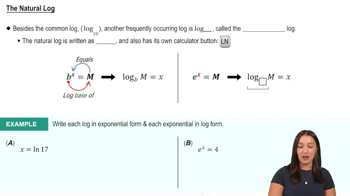
The Natural Log

Limit Evaluation Using Substitution

Evaluating limits involving complex functions often requires substitution to simplify the expression. Here, substituting x = e^y transforms the limit as x approaches 0 into a limit as y approaches -∞, making it easier to analyze the behavior of the function near zero.
Recommended video:
05:21
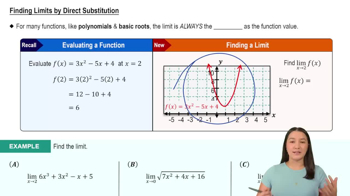
Finding Limits by Direct Substitution

Behavior of Exponential and Logarithmic Functions at Infinity

Understanding how exponential and logarithmic functions behave as their arguments approach infinity or negative infinity is crucial. For example, e^y approaches 0 as y → -∞, and ln(x) approaches -∞ as x → 0+, which helps in evaluating limits involving these functions.
Recommended video:
5:26
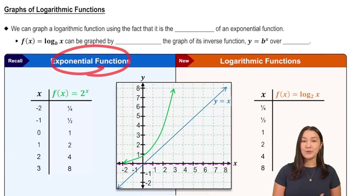
Graphs of Logarithmic Functions