Ch. 8 - Integration Techniques
Briggs - Calculus: Early Transcendentals 3rd Edition
Briggs3rd EditionCalculus: Early TranscendentalsISBN: 9780136847243Not the one you use?Change textbook
Chapter 8, Problem 8.4.46

7-56. Trigonometric substitutions Evaluate the following integrals using trigonometric substitution.
46. ∫ 1/√(1 - 2x²) dx

Verified step by step guidance
1
Step 1: Recognize the integral involves a square root of the form √(1 - 2x²). This suggests using a trigonometric substitution to simplify the expression. Specifically, use the substitution x = (1/√2)sin(θ), which ensures that 1 - 2x² becomes 1 - sin²(θ).
Step 2: Compute dx in terms of θ. Differentiating x = (1/√2)sin(θ) gives dx = (1/√2)cos(θ)dθ.
Step 3: Substitute x = (1/√2)sin(θ) and dx = (1/√2)cos(θ)dθ into the integral. The square root √(1 - 2x²) becomes √(1 - sin²(θ)), which simplifies to cos(θ). The integral now becomes ∫(1/√2)cos(θ)/(cos(θ))dθ.
Step 4: Simplify the integral. The cos(θ) terms cancel out, leaving ∫(1/√2)dθ. This is a straightforward integral of a constant.
Step 5: Integrate the constant and back-substitute θ in terms of x using the original substitution x = (1/√2)sin(θ). Use the relationship sin(θ) = √2x to express the final result in terms of x.

Verified video answer for a similar problem:

This video solution was recommended by our tutors as helpful for the problem above.
Video duration:
3m
Was this helpful?

Key Concepts

Here are the essential concepts you must grasp in order to answer the question correctly.

Trigonometric Substitution

Trigonometric substitution is a technique used in calculus to simplify integrals involving square roots of quadratic expressions. By substituting a variable with a trigonometric function, such as sine or cosine, the integral can often be transformed into a more manageable form. This method is particularly useful for integrals that contain expressions like √(1 - x²) or √(x² - a²).
Recommended video:
6:04
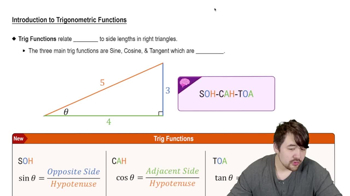
Introduction to Trigonometric Functions

Pythagorean Identity

The Pythagorean identity states that for any angle θ, sin²(θ) + cos²(θ) = 1. This identity is fundamental in trigonometric substitution as it allows us to express one trigonometric function in terms of another, facilitating the simplification of integrals. For example, if we let x = sin(θ), then √(1 - x²) becomes cos(θ), which can simplify the integral significantly.
Recommended video:
7:17
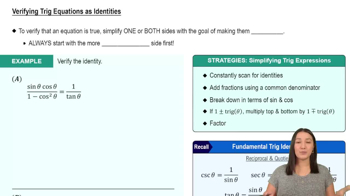
Verifying Trig Equations as Identities

Integral Evaluation

Integral evaluation is the process of finding the antiderivative of a function, which can often be achieved through various techniques, including substitution, integration by parts, or trigonometric identities. In the context of trigonometric substitution, once the integral is transformed into a trigonometric form, it can be evaluated using standard integral formulas. After finding the antiderivative, it is essential to revert back to the original variable to express the final answer.
Recommended video:
5:14
Evaluate Logarithms