
Textbook Question
33–42. Solving initial value problems Solve the following initial value problems.
y''(t) = teᵗ, y(0) = 0, y'(0) = 1
69
views

 Verified step by step guidance
 06:06
06:06
 6:04
6:04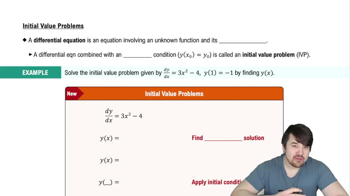 05:03
05:0333–42. Solving initial value problems Solve the following initial value problems.
y''(t) = teᵗ, y(0) = 0, y'(0) = 1
45–46. Harvesting problems Consider the harvesting problem in Example 6.
If r = 0.05 and H = 500, for what values of p₀ is the amount of the resource decreasing? For what value of p₀ is the amount of the resource constant? If p₀ = 9000, when does the resource vanish?
11–16. Initial value problems Solve the following initial value problems.
y'(t) − 3y = 12, y(1) = 4
17–18. {Use of Tech} Designing logistic functions Use the method of Example 1 to find a logistic function that describes the following populations. Graph the population function.
The population increases from 50 to 60 in the first month and eventually levels off at 150.
Explain how to solve a separable differential equation of the form
g(t)y'(y) = h(t)
27–30. Newton’s Law of Cooling Solve the differential equation for Newton’s Law of Cooling to find the temperature function in the following cases. Then answer any additional questions.
An iron rod is removed from a blacksmith’s forge at a temperature of 900°C . Assume k=0.02 and the rod cools in a room with a temperature of 30°C When does the temperature of the rod reach 100°C?