Ch. 9 - Differential Equations
Briggs - Calculus: Early Transcendentals 3rd Edition
Briggs3rd EditionCalculus: Early TranscendentalsISBN: 9780136847243Not the one you use?Change textbook
Chapter 9, Problem 9.5.33

Solution of the logistic equation Use separation of variables to show that the solution of the initial value problem
P'(t) = rP (1-P/K), P(0) = P₀
is P(t) = K/((K/P₀ − 1)e⁻ʳᵗ + 1)

Verified step by step guidance
1
Start with the logistic differential equation given: \(P'(t) = rP \left(1 - \frac{P}{K}\right)\), where \(r\) and \(K\) are constants, and \(P(0) = P_0\) is the initial condition.
Rewrite the differential equation in separable form by dividing both sides by \(P \left(1 - \frac{P}{K}\right)\) and multiplying both sides by \(dt\): \(\frac{dP}{P \left(1 - \frac{P}{K}\right)} = r \, dt\).
Simplify the left side by expressing the denominator as a single fraction: \(P \left(1 - \frac{P}{K}\right) = P \left(\frac{K - P}{K}\right) = \frac{P(K - P)}{K}\), so the integral becomes \(\int \frac{K}{P(K - P)} \, dP = \int r \, dt\).
Use partial fraction decomposition to rewrite \(\frac{K}{P(K - P)}\) as \(\frac{A}{P} + \frac{B}{K - P}\), then solve for constants \(A\) and \(B\). After finding \(A\) and \(B\), integrate both sides: \(\int \left(\frac{A}{P} + \frac{B}{K - P}\right) dP = \int r \, dt\).
After integrating, apply the initial condition \(P(0) = P_0\) to solve for the constant of integration. Finally, solve the resulting equation for \(P(t)\) to obtain the explicit solution: \(P(t) = \frac{K}{\left(\frac{K}{P_0} - 1\right) e^{-rt} + 1}\).

Verified video answer for a similar problem:

This video solution was recommended by our tutors as helpful for the problem above.
Video duration:
7m

Key Concepts

Here are the essential concepts you must grasp in order to answer the question correctly.

Logistic Differential Equation

The logistic differential equation models population growth with a carrying capacity, expressed as P'(t) = rP(1 - P/K). Here, r is the growth rate, K is the maximum population, and P(t) is the population at time t. It describes growth that slows as the population approaches K.
Recommended video:
07:39
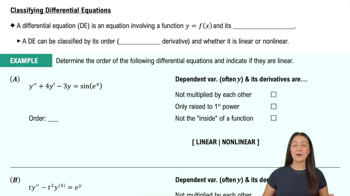
Classifying Differential Equations

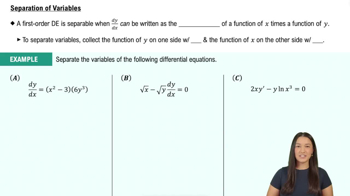
Separation of Variables

Separation of variables is a method to solve differential equations by rewriting them so that each variable and its differential are on opposite sides. For the logistic equation, this involves isolating terms with P on one side and t on the other before integrating both sides.
Recommended video:
07:15
Separation of Variables

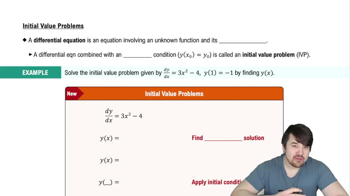
Initial Value Problem and Integration Constants

An initial value problem specifies the value of the solution at a particular point, here P(0) = P₀. After integrating, the constant of integration is determined using this initial condition to find the particular solution that fits the problem.
Recommended video:
Guided course
05:03
Initial Value Problems