Ch. 1 - Functions
Hass - Thomas' Calculus 15th Edition
Hass15th EditionThomas' CalculusISBN: 9780137616077Not the one you use?Change textbook
Chapter 1, Problem 1.1.30a

Piecewise-Defined Functions


Find a formula for each function graphed in Exercises 29–32.


a. <IMAGE>

Verified step by step guidance
1
Identify the different segments of the piecewise function from the graph. Look for changes in slope, discontinuities, or different behaviors in different intervals.
Determine the domain for each segment. This involves identifying the x-values over which each segment is defined.
For each segment, determine the type of function it represents (e.g., linear, quadratic, constant) by analyzing the graph's shape and behavior.
Write the equation for each segment using the appropriate function type. For linear segments, use the slope-intercept form: y=mx+b, where m is the slope and b is the y-intercept.
Combine the equations into a piecewise function, specifying the domain for each segment. Use the format: f(x)={expression,condition.

Verified video answer for a similar problem:

This video solution was recommended by our tutors as helpful for the problem above.
Video duration:
3m
Was this helpful?

Key Concepts

Here are the essential concepts you must grasp in order to answer the question correctly.

Piecewise-Defined Functions

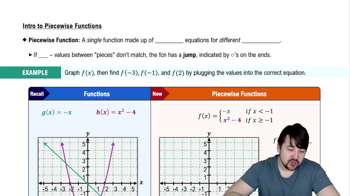
Piecewise-defined functions are functions that have different expressions or rules for different intervals of the domain. They are useful for modeling situations where a function behaves differently in different scenarios. Understanding how to interpret and construct these functions is crucial for analyzing graphs that change behavior at specific points.
Recommended video:
05:36
Piecewise Functions

Graph Interpretation

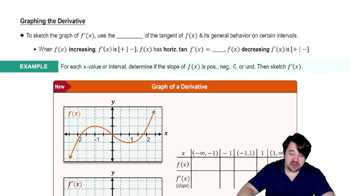
Graph interpretation involves analyzing the visual representation of a function to understand its behavior, such as identifying intervals, slopes, and points of discontinuity. This skill is essential for translating a graph into a piecewise-defined function, as it helps determine the different expressions that apply to each segment of the graph.
Recommended video:
06:15
Graphing The Derivative

Function Formulation

Function formulation is the process of creating mathematical expressions that accurately represent a function's behavior. For piecewise-defined functions, this involves writing separate expressions for each interval of the domain, ensuring continuity and correct representation of the graph's features. Mastery of this concept allows for precise modeling of complex functions.
Recommended video:
06:21
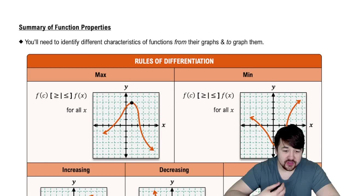
Properties of Functions