Ch. 2 - Limits and Continuity
Hass - Thomas' Calculus 15th Edition
Hass15th EditionThomas' CalculusISBN: 9780137616077Not the one you use?Change textbook
Chapter 2, Problem 2.6.35

Limits as x → ∞ or x → −∞


The process by which we determine limits of rational functions applies equally well to ratios containing noninteger or negative powers of x. Divide numerator and denominator by the highest power of x in the denominator and proceed from there. Find the limits in Exercises 23–36. Write ∞ or −∞ where appropriate.


lim x→∞ (x − 3) / √(4x² + 25)

Verified step by step guidance
1
Identify the highest power of x in the denominator. In this case, the highest power is x² under the square root, which simplifies to x when considering the square root.
Divide both the numerator and the denominator by x, the highest power of x in the denominator. This gives us: (x/x - 3/x) / (√(4x² + 25)/x).
Simplify the expression: The numerator becomes (1 - 3/x) and the denominator becomes √(4 + 25/x²).
Evaluate the limit as x approaches infinity: As x → ∞, 3/x approaches 0 and 25/x² approaches 0.
The expression simplifies to (1 - 0) / √(4 + 0), which further simplifies to 1/√4. Calculate the final limit value from this simplified expression.

Verified video answer for a similar problem:

This video solution was recommended by our tutors as helpful for the problem above.
Video duration:
2m
Was this helpful?

Key Concepts

Here are the essential concepts you must grasp in order to answer the question correctly.

Limits at Infinity

Limits at infinity involve finding the behavior of a function as the variable approaches positive or negative infinity. This concept helps determine the end behavior of functions, particularly rational functions, by analyzing the dominant terms. Understanding limits at infinity is crucial for evaluating how functions grow or shrink without bound.
Recommended video:
03:07
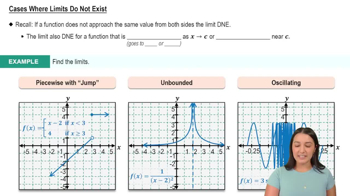
Cases Where Limits Do Not Exist

Rational Functions

Rational functions are expressions formed by the ratio of two polynomials. To find limits involving rational functions, especially as x approaches infinity, it's essential to identify the highest power of x in the denominator and numerator. This helps simplify the function and determine its limit by focusing on the dominant terms that influence the function's behavior.
Recommended video:
6:04
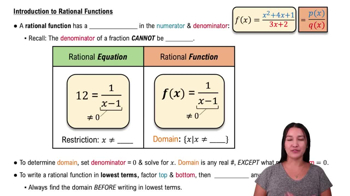
Intro to Rational Functions

Simplification Techniques

Simplification techniques involve dividing the numerator and denominator by the highest power of x present in the denominator. This process reduces the complexity of the function, allowing for easier evaluation of limits. By simplifying, we can isolate terms that significantly impact the limit, making it possible to determine the function's behavior as x approaches infinity.
Recommended video:
05:03
Initial Value Problems