Ch. 2 - Limits and Continuity
Hass - Thomas' Calculus 15th Edition
Hass15th EditionThomas' CalculusISBN: 9780137616077Not the one you use?Change textbook
Chapter 2, Problem 2.4.28

Using limθ→0 sin θ / θ = 1


Find the limits in Exercises 23–46.


limt→0 2t / tan t

Verified step by step guidance
1
Recognize that the limit involves a trigonometric function, specifically tan(t), which can be expressed in terms of sin(t) and cos(t). Recall that tan(t) = sin(t) / cos(t).
Rewrite the expression 2t / tan(t) as 2t / (sin(t) / cos(t)), which simplifies to 2t * (cos(t) / sin(t)).
This can be further simplified to (2t * cos(t)) / sin(t).
To apply the known limit lim(θ→0) sin(θ) / θ = 1, rewrite the expression as (2 * cos(t)) * (t / sin(t)).
Recognize that as t approaches 0, t / sin(t) approaches 1, and cos(t) approaches cos(0) = 1. Therefore, the limit can be evaluated by considering the product of these limits: 2 * 1 * 1.

Verified video answer for a similar problem:

This video solution was recommended by our tutors as helpful for the problem above.
Video duration:
3m
Was this helpful?

Key Concepts

Here are the essential concepts you must grasp in order to answer the question correctly.

Limit of a Function

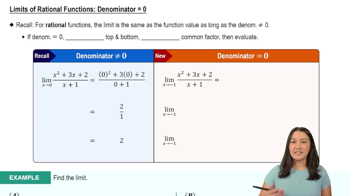
The limit of a function describes the value that a function approaches as the input approaches a certain point. In calculus, limits are fundamental for understanding continuity, derivatives, and integrals. The notation lim(x→a) f(x) indicates the limit of f(x) as x approaches a. Evaluating limits often involves techniques such as substitution, factoring, or using special limit properties.
Recommended video:
06:11
Limits of Rational Functions: Denominator = 0

Trigonometric Limits

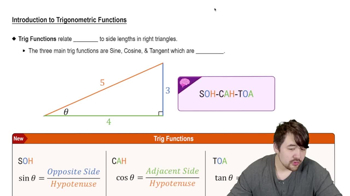
Trigonometric limits, particularly those involving sine and tangent functions, are essential in calculus. A key result is lim(θ→0) sin(θ)/θ = 1, which helps evaluate limits involving sine and tangent as they approach zero. This result is crucial for simplifying expressions and solving problems that involve trigonometric functions, especially in the context of derivatives and integrals.
Recommended video:
6:04
Introduction to Trigonometric Functions

L'Hôpital's Rule

L'Hôpital's Rule is a method for evaluating limits that result in indeterminate forms like 0/0 or ∞/∞. It states that if the limit of f(x)/g(x) as x approaches a yields an indeterminate form, then the limit can be found by taking the derivative of the numerator and the derivative of the denominator. This rule simplifies the process of finding limits, especially when dealing with complex functions.
Recommended video: