Ch. 7 - Transcendental Functions
Hass - Thomas' Calculus 15th Edition
Hass15th EditionThomas' CalculusISBN: 9780137616077Not the one you use?Change textbook
Chapter 7, Problem 7.7.80

80. Volume The region enclosed by the curve y=sech(x), the x-axis, and the lines x=±ln√3 is revolved about the x-axis to generate a solid. Find the volume of the solid.

Verified step by step guidance
1
Identify the region to be revolved: it is bounded by the curve \(y = \text{sech}(x)\), the x-axis (\(y=0\)), and the vertical lines \(x = -\ln\sqrt{3}\) and \(x = \ln\sqrt{3}\).
Recall the formula for the volume of a solid of revolution about the x-axis using the disk method: \(V = \pi \int_{a}^{b} [f(x)]^2 \, dx\), where \(f(x)\) is the function being revolved.
Set up the integral for the volume: \(V = \pi \int_{-\ln\sqrt{3}}^{\ln\sqrt{3}} \left( \text{sech}(x) \right)^2 \, dx\).
Use the identity \(\text{sech}(x) = \frac{1}{\cosh(x)}\), so the integrand becomes \(\text{sech}^2(x) = \frac{1}{\cosh^2(x)}\).
Evaluate the integral \(\int \text{sech}^2(x) \, dx\), which is a standard integral with antiderivative \(\tanh(x)\), and then apply the limits \(x = -\ln\sqrt{3}\) to \(x = \ln\sqrt{3}\) to find the volume.

Verified video answer for a similar problem:

This video solution was recommended by our tutors as helpful for the problem above.
Video duration:
4m

Key Concepts

Here are the essential concepts you must grasp in order to answer the question correctly.

Volume of Solids of Revolution

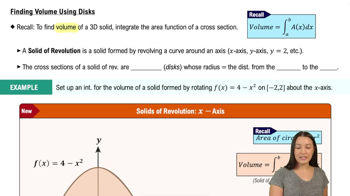
This concept involves finding the volume of a 3D solid formed by rotating a 2D region around an axis. The disk or washer method is commonly used, where the volume is computed by integrating the cross-sectional area perpendicular to the axis of rotation.
Recommended video:
04:48
Finding Volume Using Disks

Hyperbolic Secant Function (sech(x))

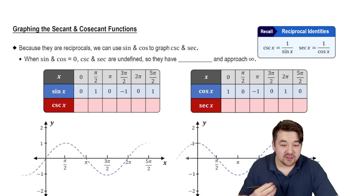
The hyperbolic secant function, sech(x), is defined as 1/cosh(x), where cosh(x) = (e^x + e^{-x})/2. Understanding its properties and behavior is essential for setting up the integral limits and integrand when calculating the volume.
Recommended video:
Guided course
6:22
Graphs of Secant and Cosecant Functions

Definite Integration with Logarithmic Limits

The problem involves integrating between x = ±ln(√3), which requires understanding how to handle logarithmic limits in definite integrals. Proper evaluation of the integral at these bounds is crucial for obtaining the exact volume.
Recommended video:
Guided course
05:43
Definition of the Definite Integral