Arc length: Find the length of the curve y = ln(sec x), 0 ≤ x ≤ π/4.
Ch. 8 - Techniques of Integration
Chapter 8, Problem 8.4.54
Solve the initial value problems in Exercises 53–56 for y as a function of x.
√(x² - 9) (dy/dx) = 1, where x > 3, y(5) = ln 3
Verified step by step guidance1
Rewrite the given differential equation in the form \( \frac{dy}{dx} = \frac{1}{\sqrt{x^2 - 9}} \) to isolate \( \frac{dy}{dx} \).
Express the differential equation as \( dy = \frac{1}{\sqrt{x^2 - 9}} dx \) to prepare for integration on both sides.
Integrate both sides: \( \int dy = \int \frac{1}{\sqrt{x^2 - 9}} dx \). The left side integrates to \( y \), and the right side requires recognizing the integral form.
Recall that \( \int \frac{1}{\sqrt{x^2 - a^2}} dx = \ln|x + \sqrt{x^2 - a^2}| + C \). Use this formula with \( a = 3 \) to write the general solution for \( y \).
Apply the initial condition \( y(5) = \ln 3 \) by substituting \( x = 5 \) and \( y = \ln 3 \) into the general solution to solve for the constant \( C \).

Verified video answer for a similar problem:
This video solution was recommended by our tutors as helpful for the problem above.
Video duration:
8mWas this helpful?
Key Concepts
Here are the essential concepts you must grasp in order to answer the question correctly.
Separable Differential Equations
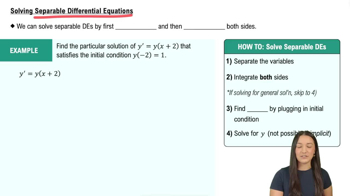
A separable differential equation can be written as a product of a function of x and a function of y, allowing variables to be separated on opposite sides of the equation. This enables integration with respect to each variable independently to find the general solution.
Recommended video:
Solving Separable Differential Equations
Initial Value Problems (IVP)
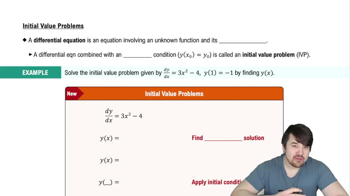
An initial value problem specifies a differential equation along with a condition that the solution must satisfy at a particular point. This condition allows determination of the unique solution curve passing through the given point.
Recommended video:
Guided course
Initial Value Problems
Integration Techniques and Inverse Functions
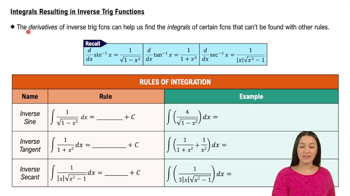
Solving the differential equation involves integrating expressions that may include radicals like √(x² - 9). Recognizing standard integral forms and applying inverse hyperbolic or logarithmic functions is essential to express the solution explicitly.
Recommended video:
Integrals Resulting in Inverse Trig Functions
Related Practice
Textbook Question
65
views
Textbook Question
Evaluate the integrals in Exercises 25–30 by using a substitution prior to integration by parts.
∫ ln(x + x²) dx
18
views
Textbook Question
Use any method to evaluate the integrals in Exercises 65–70.
∫ sin³(x) / cos⁴(x) dx
18
views
Textbook Question
In Exercises 27–40, use a substitution to change the integral into one you can find in the table. Then evaluate the integral.
∫ x^2 √(2x - x^2) dx
25
views
Textbook Question
The integrals in Exercises 1–44 are in no particular order. Evaluate each integral using any algebraic method, trigonometric identity, or substitution you think is appropriate.
∫ (sec t + cot t)² dt
24
views
Textbook Question
In Exercises 69–80, determine whether the improper integral converges or diverges. If it converges, evaluate the integral.
∫₋∞⁴ [x / (x² + 9)^(2/5)] dx
38
views