Ch. 1 - Equations and Inequalities
Lial - College Algebra 13th Edition
Lial13th EditionCollege AlgebraISBN: 9780136881063Not the one you use?Change textbook
Chapter 2, Problem 48b

See Exercise 47. (b)Which equation has two nonreal complex solutions?

Verified step by step guidance
1
Step 1: Understand that an equation with two nonreal complex solutions typically comes from a quadratic equation where the discriminant is negative. The discriminant \( D \) is given by the formula \( D = b^2 - 4ac \) for a quadratic equation \( ax^2 + bx + c = 0 \).
Step 2: Identify the quadratic equations given in Exercise 47. For each equation, write down the coefficients \( a \), \( b \), and \( c \).
Step 3: Calculate the discriminant \( D = b^2 - 4ac \) for each quadratic equation using the coefficients found in Step 2.
Step 4: Analyze the value of each discriminant. If \( D < 0 \), then the quadratic equation has two nonreal complex solutions.
Step 5: Select the equation(s) from Exercise 47 whose discriminant is negative, indicating that it has two nonreal complex solutions.

Verified video answer for a similar problem:

This video solution was recommended by our tutors as helpful for the problem above.
Video duration:
2m
Was this helpful?

Key Concepts

Here are the essential concepts you must grasp in order to answer the question correctly.

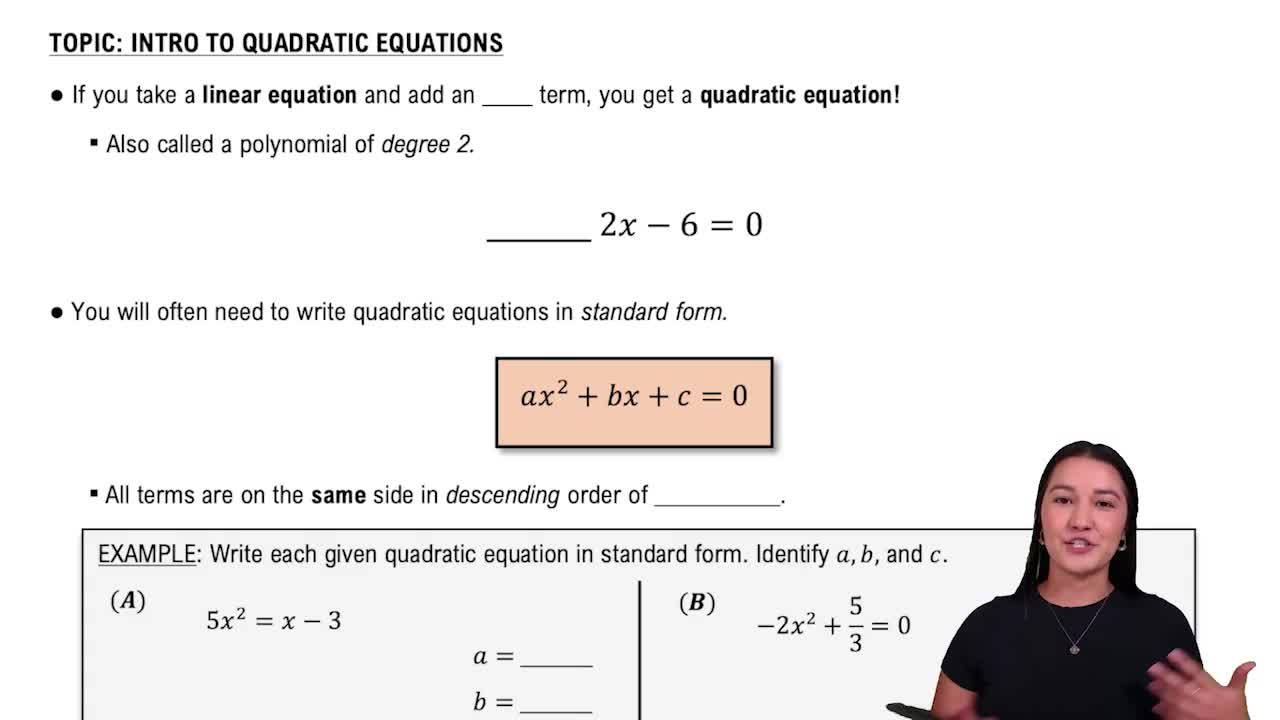
Quadratic Equations

A quadratic equation is a second-degree polynomial equation of the form ax² + bx + c = 0. It can have two solutions, which may be real or complex, depending on the coefficients a, b, and c.
Recommended video:
05:35
Introduction to Quadratic Equations

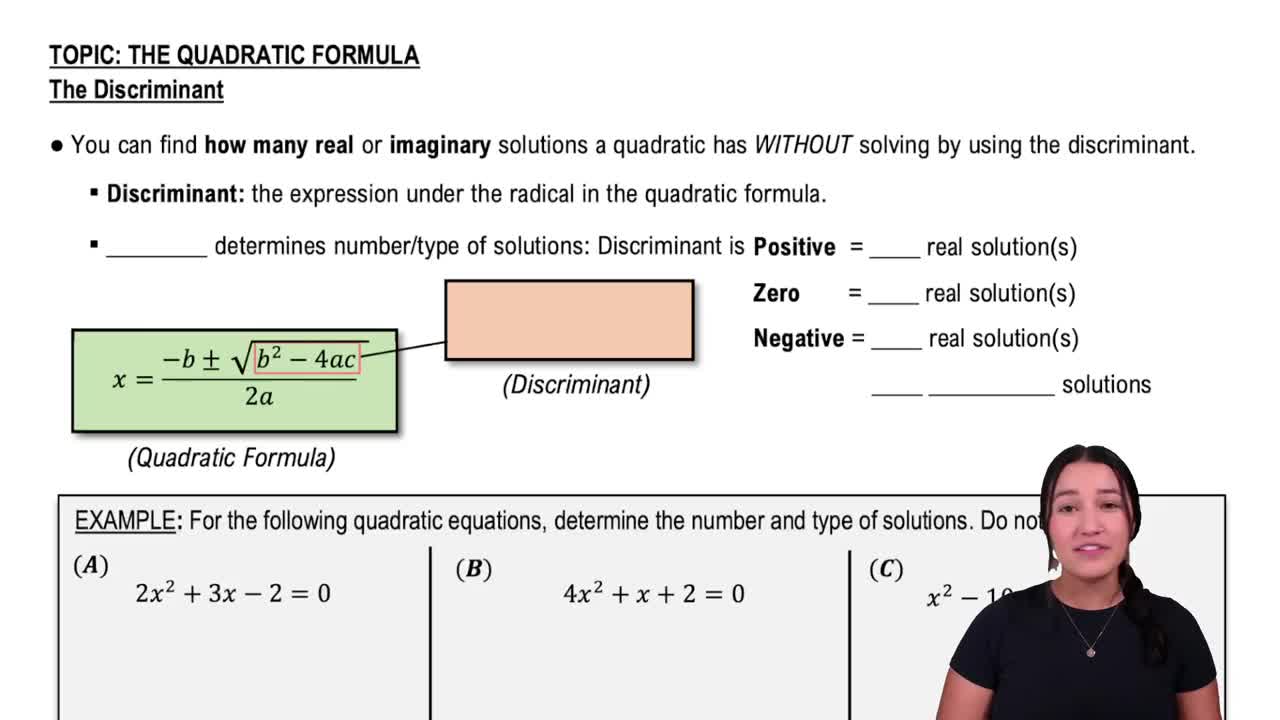
Discriminant and Nature of Roots

The discriminant, given by b² - 4ac, determines the nature of the roots of a quadratic equation. If the discriminant is negative, the equation has two nonreal complex solutions, which are conjugates.
Recommended video:
04:11
The Discriminant

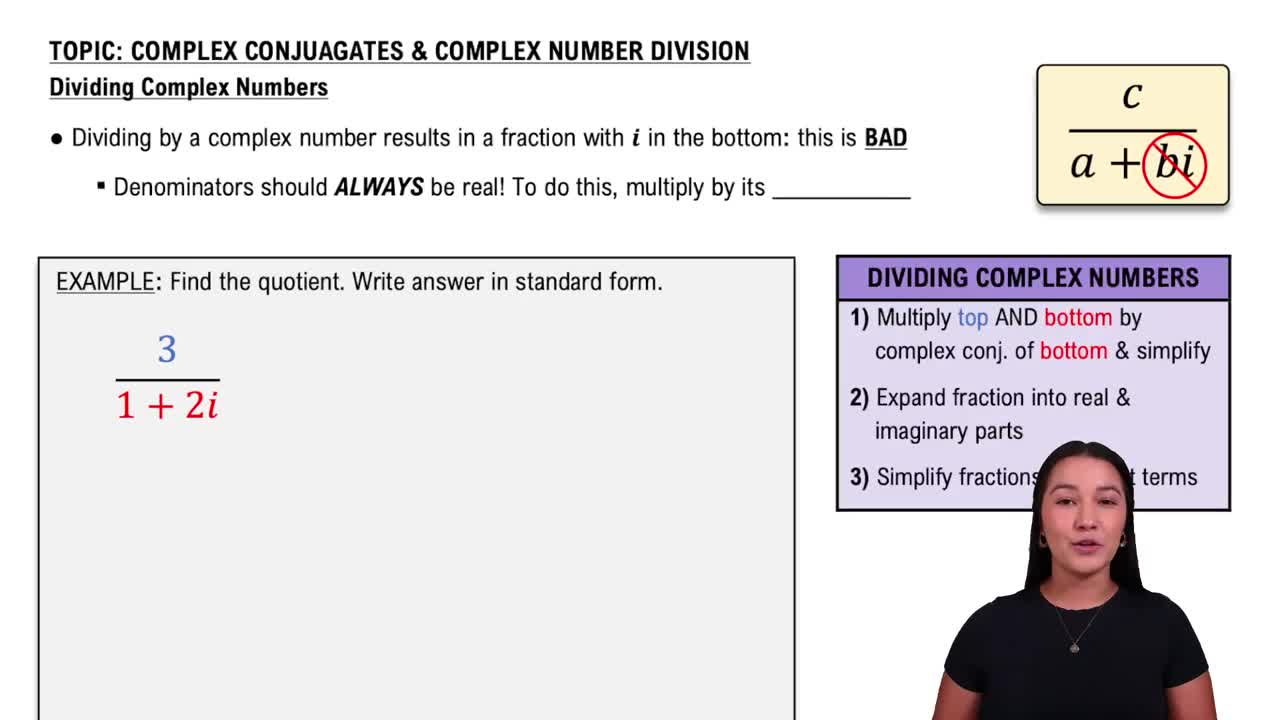
Complex Numbers

Complex numbers include a real part and an imaginary part, expressed as a + bi where i² = -1. Nonreal complex solutions arise when solving quadratics with negative discriminants, involving imaginary numbers.
Recommended video:
04:22
Dividing Complex Numbers