
Textbook Question
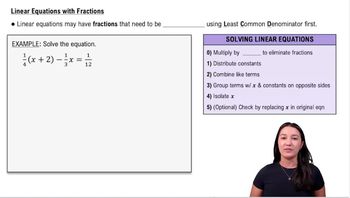
Solve each equation. 6(3x-1)= 8 - (10x-14)
908
views

 Verified step by step guidance
 08:07
08:07
 04:02
04:02 05:21
05:21Solve each equation. 6(3x-1)= 8 - (10x-14)
Solve each equation using the zero-factor property. x2 - 5x + 6 = 0
Solve each problem. Speed of a Plane Mary Lynn left by plane to visit her mother in Louisiana, 420 km away. Fifteen minutes later, her mother left to meet her at the airport. She drove the 20 km to the airport at 40 km per hr, arriving just as the plane taxied in. What was the speed of the plane?
Determine the values of the variable that cannot possibly be solutions of each equation. Do not solve. 3/(x-2) + 1/(x+1) = 3/(x2-x-2)
Solve each problem. See Example 1. The length of a rectangular label is 2.5 cm less than twice the width. The perimeter is 40.6 cm. Find the width.
Use the following facts. If x represents an integer, then x+1 represents the next consecutive integer. If x represents an even integer, then x+2 represents the next consecutive even integer. If x represents an odd integer, then x+2 represents the next consecutive odd integer. Find two consecutive odd integers whose product is 143.