Ch. 1 - Equations and Inequalities
Lial - College Algebra 13th Edition
Lial13th EditionCollege AlgebraISBN: 9780136881063Not the one you use?Change textbook
Chapter 2, Problem 60

Solve each equation using the quadratic formula. (2/3)x2 + (1/4)x = 3

Verified step by step guidance
1
Rewrite the given equation in standard quadratic form \(a x^2 + b x + c = 0\). Start by moving all terms to one side: \(\frac{2}{3}x^2 + \frac{1}{4}x - 3 = 0\).
Identify the coefficients \(a\), \(b\), and \(c\) from the quadratic equation: \(a = \frac{2}{3}\), \(b = \frac{1}{4}\), and \(c = -3\).
Write down the quadratic formula: \(x = \frac{-b \pm \sqrt{b^2 - 4 a c}}{2 a}\).
Substitute the values of \(a\), \(b\), and \(c\) into the quadratic formula: \(x = \frac{-\frac{1}{4} \pm \sqrt{\left(\frac{1}{4}\right)^2 - 4 \cdot \frac{2}{3} \cdot (-3)}}{2 \cdot \frac{2}{3}}\).
Simplify the expression under the square root (the discriminant) and the denominator step-by-step to prepare for solving for \(x\).

Verified video answer for a similar problem:

This video solution was recommended by our tutors as helpful for the problem above.
Video duration:
5m
Was this helpful?

Key Concepts

Here are the essential concepts you must grasp in order to answer the question correctly.

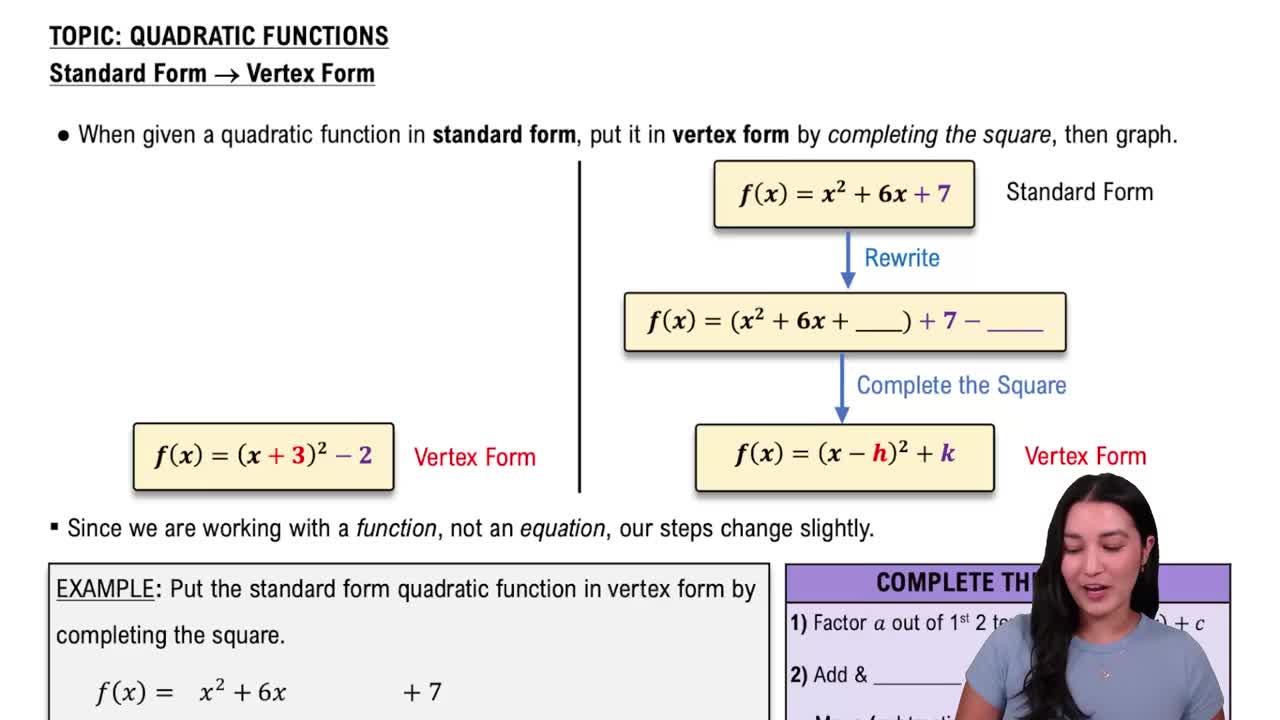
Quadratic Equation Standard Form

A quadratic equation is typically written in the form ax² + bx + c = 0, where a, b, and c are constants and a ≠ 0. To use the quadratic formula, the equation must first be rearranged into this standard form by moving all terms to one side.
Recommended video:
04:34
Converting Standard Form to Vertex Form

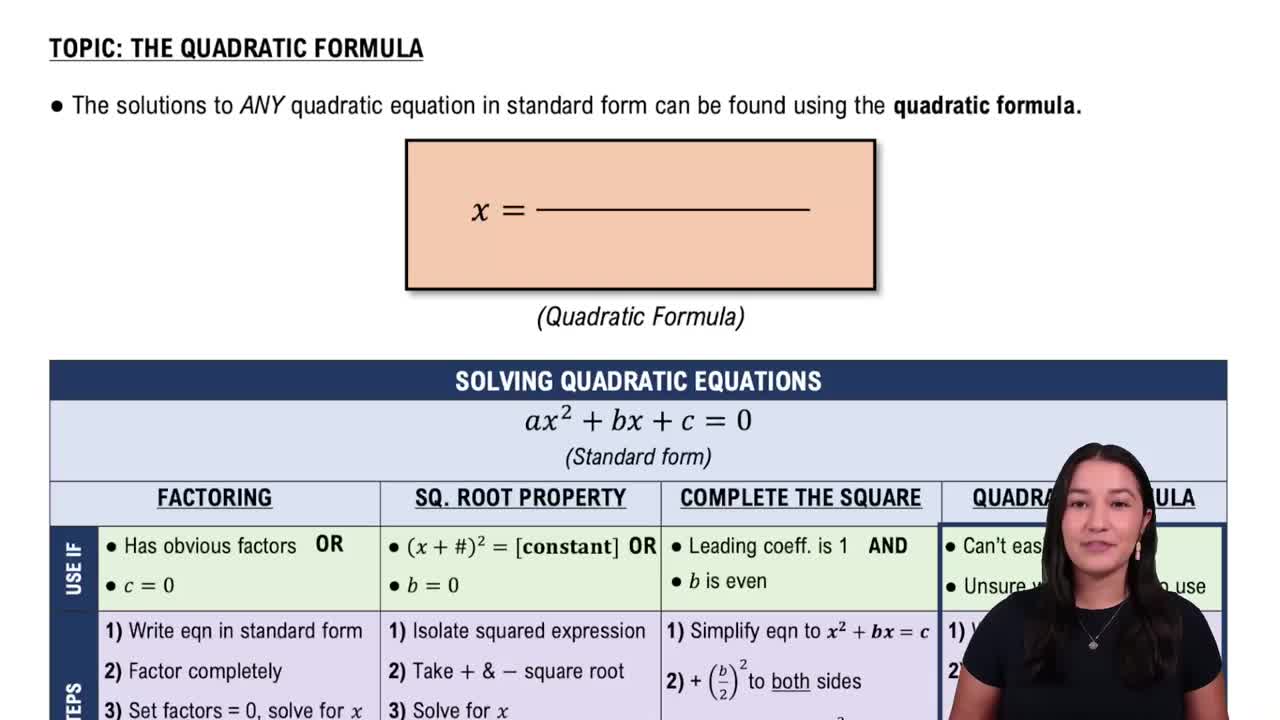
Quadratic Formula

The quadratic formula x = (-b ± √(b² - 4ac)) / (2a) provides the solutions to any quadratic equation ax² + bx + c = 0. It uses the coefficients a, b, and c to find the roots, including real and complex solutions.
Recommended video:
06:36
Solving Quadratic Equations Using The Quadratic Formula

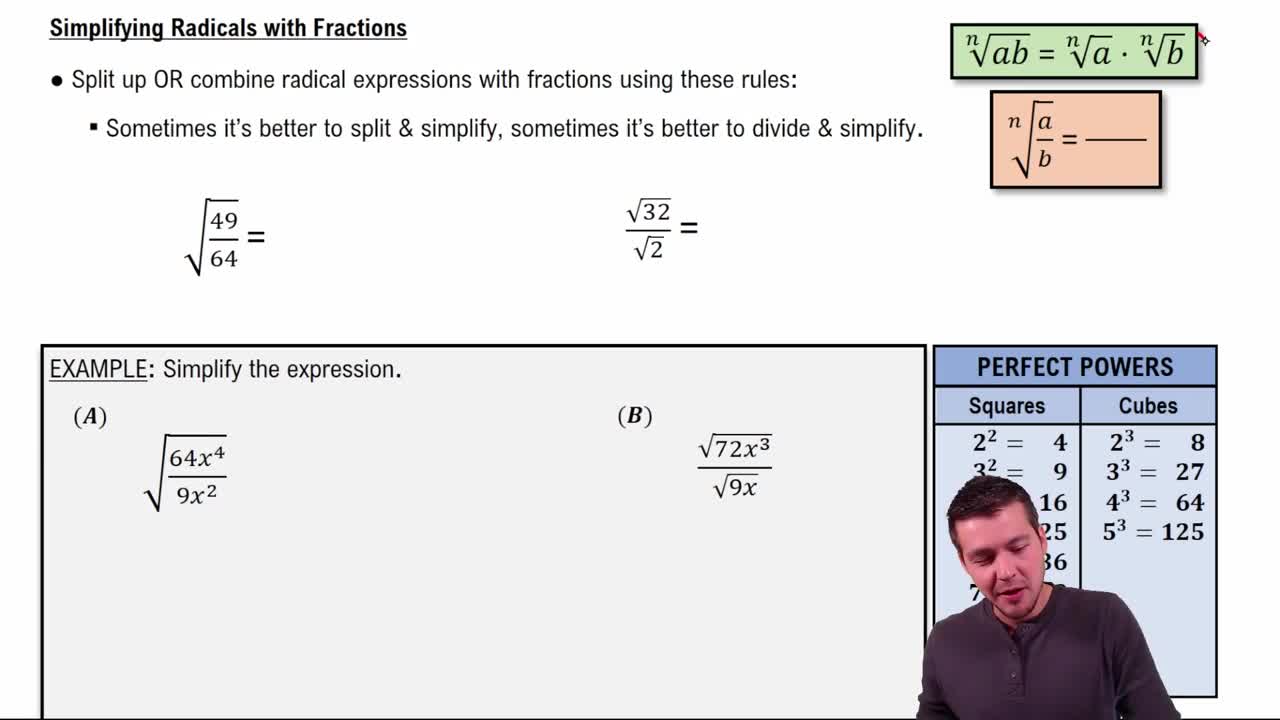
Simplifying Fractions and Radicals

When coefficients are fractions, it is important to carefully handle arithmetic operations, including finding common denominators and simplifying radicals under the square root. Accurate simplification ensures correct solutions when applying the quadratic formula.
Recommended video:
Guided course
05:45
Radical Expressions with Fractions