Ch. 4 - Exponential and Logarithmic Functions
Blitzer - College Algebra 8th Edition
Blitzer8th EditionCollege AlgebraISBN: 9780136970514Not the one you use?Change textbook
Chapter 5, Problem 21

Evaluate each expression without using a calculator. log4 16

Verified step by step guidance
1
Recognize that the expression \( \log_4 16 \) asks for the exponent to which the base 4 must be raised to get 16.
Express 16 as a power of 4. Since 16 is \( 4^2 \), rewrite the expression as \( \log_4 (4^2) \).
Use the logarithmic identity \( \log_b (b^k) = k \) to simplify \( \log_4 (4^2) \) to 2.
Conclude that \( \log_4 16 = 2 \) because 4 raised to the power 2 equals 16.
Thus, the value of the logarithm is the exponent 2.

Verified video answer for a similar problem:

This video solution was recommended by our tutors as helpful for the problem above.
Video duration:
1m
Was this helpful?

Key Concepts

Here are the essential concepts you must grasp in order to answer the question correctly.

Logarithm Definition

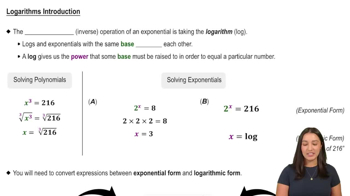
A logarithm answers the question: to what exponent must the base be raised to produce a given number? For example, log_b(a) = c means b^c = a. Understanding this definition is essential to evaluate logarithmic expressions.
Recommended video:
7:30
Logarithms Introduction

Properties of Exponents

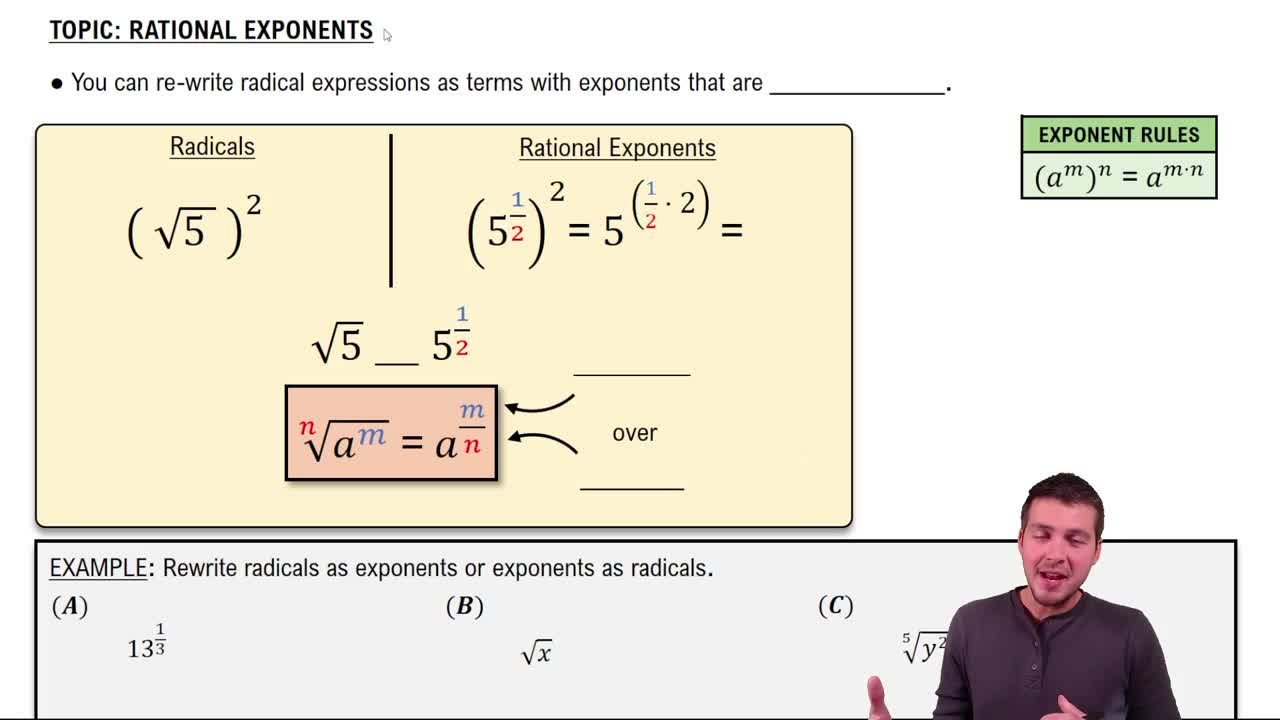
Since logarithms are closely related to exponents, knowing how to express numbers as powers of a base helps simplify logarithms. For instance, recognizing that 16 = 4^2 allows you to rewrite log_4(16) as log_4(4^2).
Recommended video:
Guided course
04:06
Rational Exponents

Logarithm Power Rule

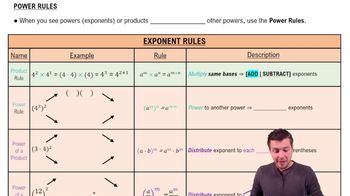
The power rule states that log_b(a^n) = n * log_b(a). This property allows you to bring the exponent in the argument down as a multiplier, simplifying the evaluation of logarithms when the argument is a power of the base.
Recommended video:
Related Practice
Textbook Question

The graph of an exponential function is given. Select the function for each graph from the following options:

f(x)=3x,g(x)=3x1,h(x)=3x1,f(x)=3x,G(x)=3x,H(x)=3x.f(x) = 3^x, \(\quad\) g(x) = 3^{x-1}, \(\quad\) h(x) = 3^x - 1, \(\f\)(x) = -3^x, \(\quad\) G(x) = 3^{-x}, \(\quad\) H(x) = -3^{-x}.

1025
views
Textbook Question

Use properties of logarithms to expand each logarithmic expression as much as possible. Where possible, evaluate logarithmic expressions without using a calculator. logb (x2 y)

821
views
Textbook Question

In Exercises 19–29, evaluate each expression without using a calculator. If evaluation is not possible, state the reason. log16 4

904
views
Textbook Question

The graph of an exponential function is given. Select the function for each graph from the following options:

f(x)=3x,g(x)=3x1,h(x)=3x1,f(x)=3x,G(x)=3x,H(x)=3x.f(x) = 3^x, \(\quad\) g(x) = 3^{x-1}, \(\quad\) h(x) = 3^x - 1, \(\f\)(x) = -3^x, \(\quad\) G(x) = 3^{-x}, \(\quad\) H(x) = -3^{-x}.

1483
views
Textbook Question

Use properties of logarithms to expand each logarithmic expression as much as possible. Where possible, evaluate logarithmic expressions without using a calculator. log4(x64)\(\log\)_4\(\left\)(\(\frac{\sqrt{x}\)}{64}\(\right\))

814
views
Textbook Question

Solve each exponential equation in Exercises 1–22 by expressing each side as a power of the same base and then equating exponents. e(x+1)=1/e

745
views