Ch. 4 - Inverse, Exponential, and Logarithmic Functions
Lial - College Algebra 13th Edition
Lial13th EditionCollege AlgebraISBN: 9780136881063Not the one you use?Change textbook
Chapter 5, Problem 18

If the statement is in exponential form, write it in an equivalent logarithmic form. If the statement is in logarithmic form, write it in exponential form. log4 1/64 = -3

Verified step by step guidance
1
Identify the given logarithmic statement: \(\log_{4} \frac{1}{64} = -3\).
Recall the relationship between logarithmic and exponential forms: \(\log_{b} a = c\) is equivalent to \(b^{c} = a\).
Apply this relationship to the given statement by setting the base \(b = 4\), the result of the logarithm \(c = -3\), and the argument \(a = \frac{1}{64}\).
Rewrite the logarithmic equation in exponential form as \(4^{-3} = \frac{1}{64}\).
This expresses the original logarithmic statement in its equivalent exponential form.

Verified video answer for a similar problem:

This video solution was recommended by our tutors as helpful for the problem above.
Video duration:
1m
Was this helpful?

Key Concepts

Here are the essential concepts you must grasp in order to answer the question correctly.

Definition of Logarithms

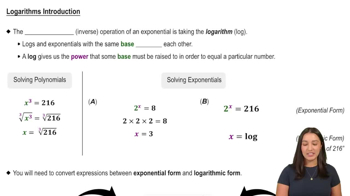
A logarithm answers the question: to what exponent must the base be raised to produce a given number? Formally, if log_b(a) = c, then b^c = a. Understanding this definition is essential to convert between logarithmic and exponential forms.
Recommended video:
7:30
Logarithms Introduction

Conversion Between Exponential and Logarithmic Forms

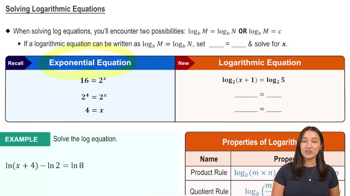
Exponential and logarithmic forms are two ways of expressing the same relationship. The exponential form b^c = a corresponds to the logarithmic form log_b(a) = c. Recognizing this equivalence allows one to rewrite expressions from one form to the other.
Recommended video:
5:02
Solving Logarithmic Equations

Properties of Logarithms and Exponents with Fractions and Negative Exponents

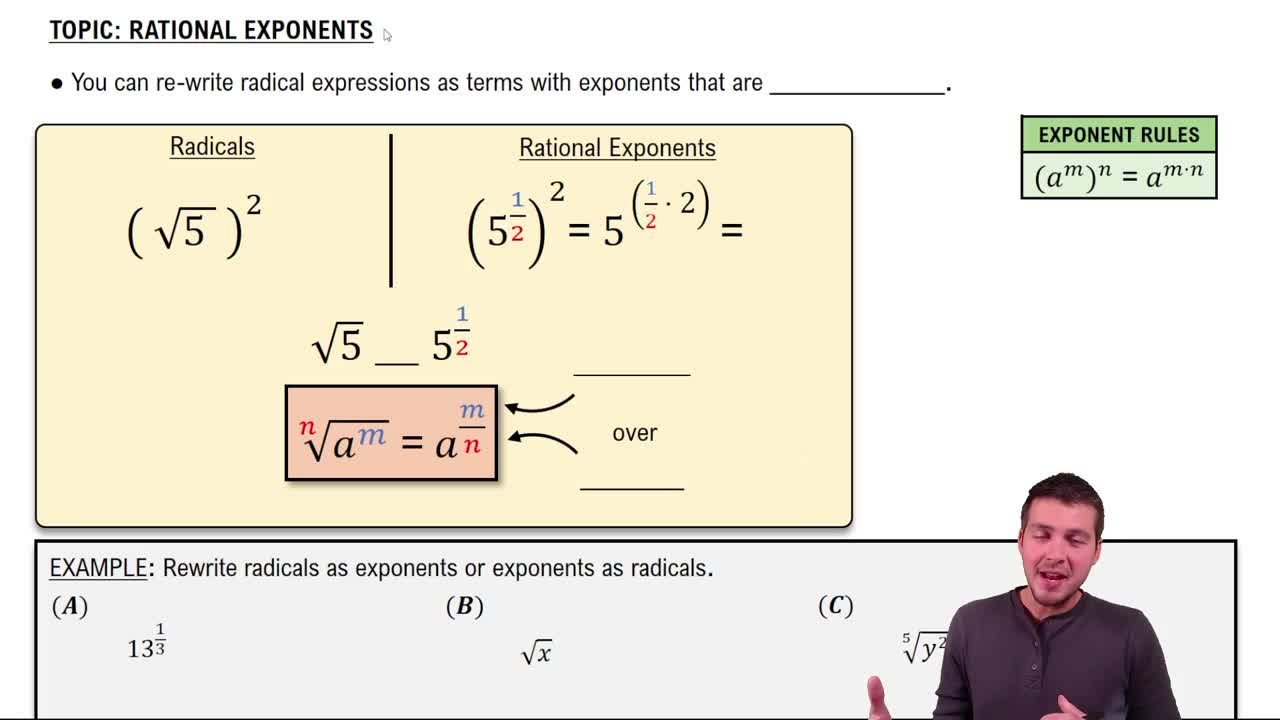
Understanding how exponents work with fractions and negative numbers is crucial. For example, a negative exponent indicates a reciprocal, and fractional bases raised to powers can produce fractions. This knowledge helps interpret and verify expressions like log_4(1/64) = -3.
Recommended video:
Guided course
04:06
Rational Exponents