
Textbook Question
Use a system of equations to solve each problem. Find an equation of the parabola y = ax2 + bx + c that passes through the points (2, 3), (-1, 0), and (-2, 2).
798
views

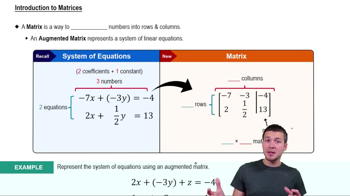
 Verified step by step guidance
 4:35
4:35
 03:42 4:35
Use a system of equations to solve each problem. Find an equation of the parabola y = ax2 + bx + c that passes through the points (2, 3), (-1, 0), and (-2, 2).
The graphs show regions of feasible solutions. Find the maximum and minimum values of each objective function. objective function = 3x + 5y
For each pair of matrices A and B, find (a) AB and (b) BA. See Example 7.
Perform each operation, if possible.
Use Cramer's rule to solve each system of equations. If D = 0, then use another method to determine the solution set. See Examples 5–7.
-2x - 2y + 3z = 4
5x + 7y - z = 2
2x + 2y - 3z = -4
Consider the following nonlinear system. Work Exercises 75 –80 in order.
y = | x - 1 |
y = x2 - 4
Use the definition of absolute value to write y = | x - 1 | as a piecewise-defined function.