Ch. 3 - Polynomial and Rational Functions
Lial - College Algebra 13th Edition
Lial13th EditionCollege AlgebraISBN: 9780136881063Not the one you use?Change textbook
Chapter 4, Problem 31c

Show that each polynomial function has a real zero as described in parts (a) and (b). In Exercises 31 and 32, also work part (c). ƒ(x)=3x^3-8x^2+x+2 Find the zero in part (b) to three decimal places.

Verified step by step guidance
1
Identify the polynomial function given: \(f(x) = 3x^3 - 8x^2 + x + 2\).
Recall that a real zero of a polynomial function is a value of \(x\) for which \(f(x) = 0\).
To find real zeros, first use the Intermediate Value Theorem by evaluating \(f(x)\) at various points to locate intervals where the function changes sign, indicating the presence of a zero.
Once an interval containing a zero is found, apply a numerical method such as the Newton-Raphson method or the bisection method to approximate the zero to three decimal places.
Set up the Newton-Raphson iteration formula: \(x_{n+1} = x_n - \frac{f(x_n)}{f'(x_n)}\), where \(f'(x)\) is the derivative of \(f(x)\), and iterate until the desired accuracy (three decimal places) is achieved.

Verified video answer for a similar problem:

This video solution was recommended by our tutors as helpful for the problem above.
Video duration:
6m
Was this helpful?

Key Concepts

Here are the essential concepts you must grasp in order to answer the question correctly.

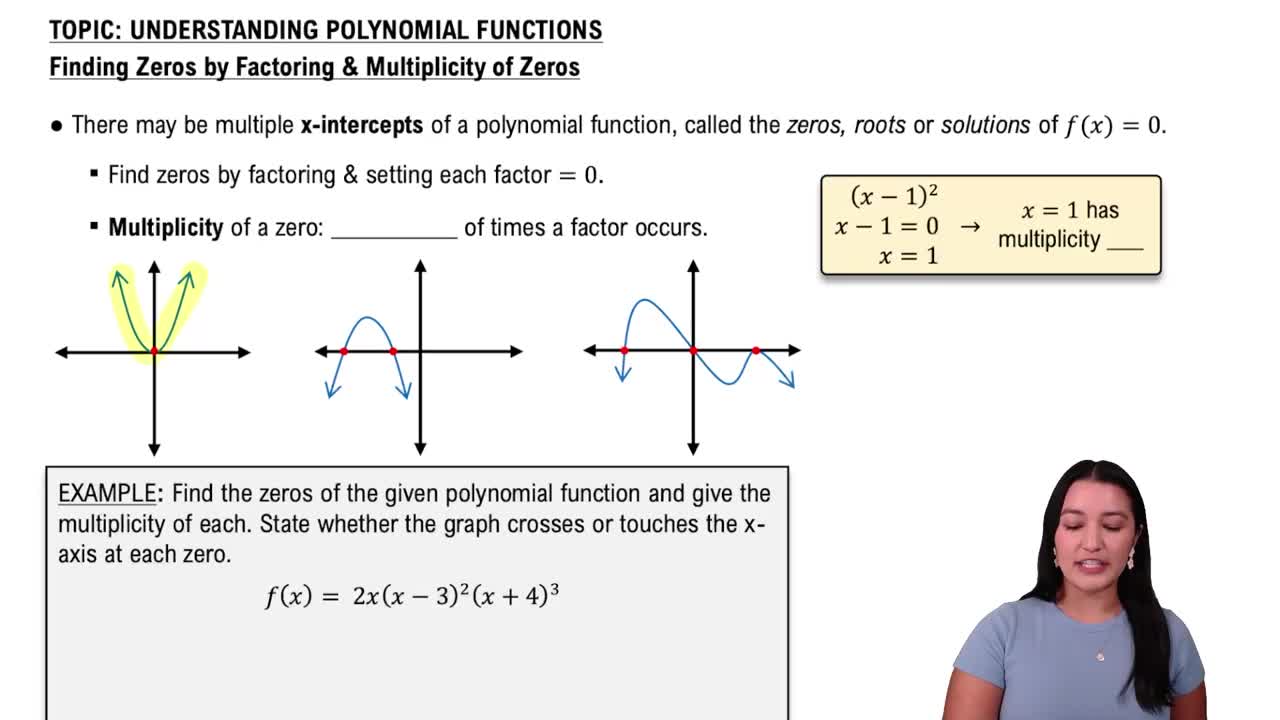
Polynomial Functions and Their Zeros

A polynomial function is an expression involving variables raised to whole-number exponents with coefficients. Zeros of a polynomial are values of x that make the function equal to zero. Understanding how to find these zeros is essential for analyzing the behavior and roots of the polynomial.
Recommended video:
03:42
Finding Zeros & Their Multiplicity

Intermediate Value Theorem

The Intermediate Value Theorem states that if a continuous function changes sign over an interval, it must have at least one root in that interval. This theorem helps to show the existence of real zeros for polynomial functions by checking values at endpoints.
Recommended video:
6:15
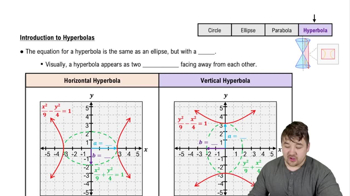
Introduction to Hyperbolas

Numerical Methods for Approximating Zeros

When exact zeros are difficult to find, numerical methods like the bisection method or Newton's method approximate zeros to a desired decimal place. These iterative techniques refine guesses to find roots accurately, such as finding a zero to three decimal places.
Recommended video:
04:03
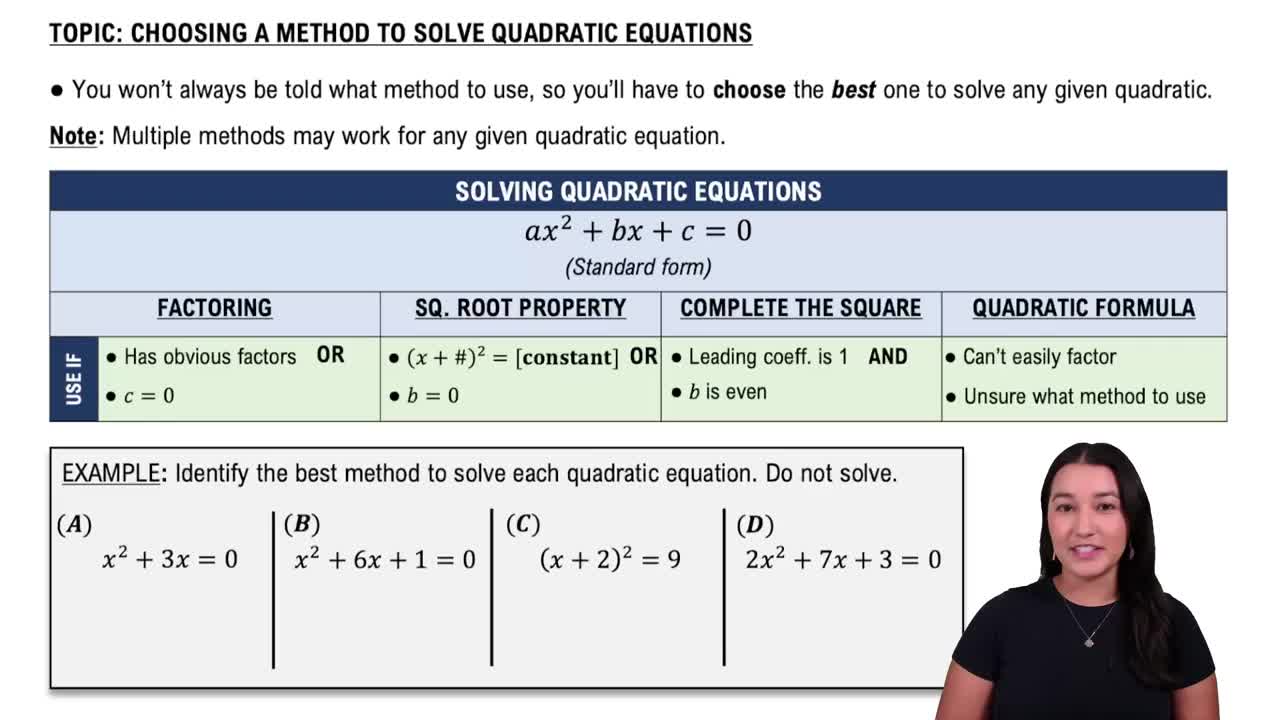
Choosing a Method to Solve Quadratics