Exercises 41–60 contain rational equations with variables in denominators. For each equation, a. write the value or values of the variable that make a denominator zero. These are the restrictions on the variable. b. Keeping the restrictions in mind, solve the equation. 1/(x - 1) + 5 = 11/(x - 1)
Ch. 1 - Equations and Inequalities

Chapter 2, Problem 47a
Write each English sentence as an equation in two variables. Then graph the equation. The y-value is four more than twice the x-value.
Verified step by step guidance1
Step 1: Start by translating the English sentence into a mathematical equation. The sentence states that 'The y-value is four more than twice the x-value.' This can be written as: .
Step 2: Identify the two variables in the equation. Here, is the independent variable (input), and is the dependent variable (output).
Step 3: To graph the equation, create a table of values. Choose a few values for (e.g., -2, -1, 0, 1, 2) and calculate the corresponding values using the equation .
Step 4: Plot the points from the table of values on a coordinate plane. For example, if , then , so plot the point (0, 4). Repeat this for all chosen values.
Step 5: Draw a straight line through the plotted points, as the equation represents a linear relationship. Label the graph with the equation for clarity.

Verified video answer for a similar problem:
This video solution was recommended by our tutors as helpful for the problem above.
Video duration:
3mWas this helpful?
Key Concepts
Here are the essential concepts you must grasp in order to answer the question correctly.
Linear Equations
Linear equations are mathematical statements that express a relationship between two variables, typically in the form y = mx + b, where m is the slope and b is the y-intercept. Understanding linear equations is essential for translating verbal statements into mathematical form, as they represent straight lines when graphed.
Recommended video:
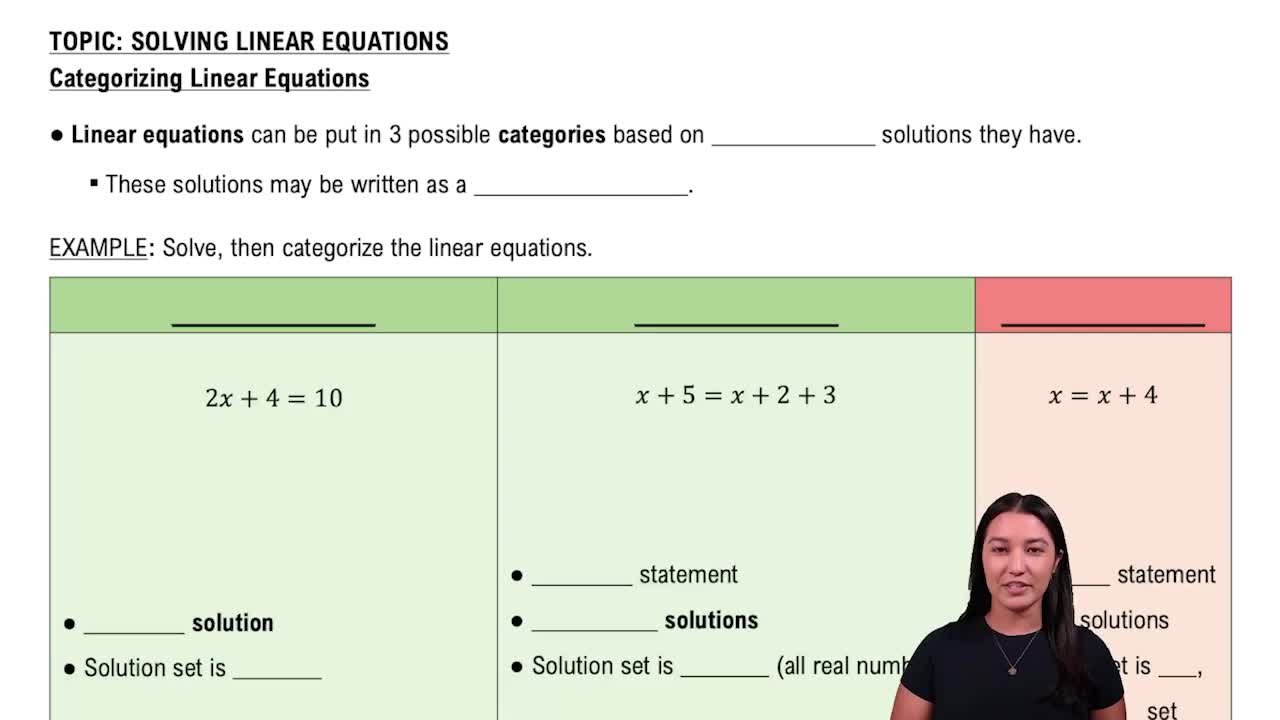
Categorizing Linear Equations
Translating English Sentences to Equations
Translating English sentences into equations involves identifying the mathematical relationships described in the text. This requires recognizing keywords and phrases that indicate operations, such as 'more than' or 'twice,' and converting them into algebraic expressions that accurately represent the relationships between the variables.
Recommended video:
Categorizing Linear Equations
Graphing Linear Equations
Graphing linear equations involves plotting points on a coordinate plane that satisfy the equation. By determining key values, such as the slope and y-intercept, one can draw a straight line that represents all solutions to the equation. This visual representation helps in understanding the relationship between the variables and analyzing their behavior.
Recommended video:
Categorizing Linear Equations
Related Practice
Textbook Question
1378
views
Textbook Question
Solve each equation in Exercises 47–64 by completing the square.
952
views
Textbook Question
Solve each equation in Exercises 41–60 by making an appropriate substitution. x(-2) - x(-1) - 6 = 0
630
views
Textbook Question
Write each English sentence as an equation in two variables. Then graph the equation. The y-value is the difference between four and twice the x-value.
897
views
Textbook Question
In Exercises 35–54, solve each formula for the specified variable. Do you recognize the formula? If so, what does it describe? S = P + Prt for r
646
views
Textbook Question
Perform the indicated operations and write the result in standard form.
898
views
1
rank