Ch. R - Review of Basic Concepts
Lial - College Algebra 13th Edition
Lial13th EditionCollege AlgebraISBN: 9780136881063Not the one you use?Change textbook
Chapter 1, Problem 115

Identify the property illustrated in each statement. Assume all variables represent real numbers. (t-6)∙(1/t-6)=1, if t-6 ≠ 0

Verified step by step guidance
1
First, observe the given expression: \((t-6) \times \left( \frac{1}{t-6} \right) = 1\), with the condition that \(t-6 \neq 0\) to avoid division by zero.
Recognize that multiplying a number by its reciprocal results in 1. Here, \((t-6)\) is multiplied by its reciprocal \(\frac{1}{t-6}\).
This illustrates the Multiplicative Inverse Property, which states that for any nonzero number \(a\), \(a \times \frac{1}{a} = 1\).
The condition \(t-6 \neq 0\) ensures that the reciprocal \(\frac{1}{t-6}\) is defined, which is necessary for the property to hold.
Therefore, the property illustrated by the equation is the Multiplicative Inverse Property.

Verified video answer for a similar problem:

This video solution was recommended by our tutors as helpful for the problem above.
Video duration:
1m
Was this helpful?

Key Concepts

Here are the essential concepts you must grasp in order to answer the question correctly.

Multiplicative Inverse Property

This property states that for any nonzero real number a, multiplying a by its reciprocal 1/a results in 1. In the given expression, (t-6) and (1/(t-6)) are multiplicative inverses, so their product equals 1, provided t-6 ≠ 0.
Recommended video:
5:36
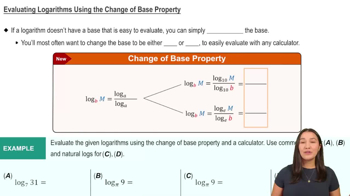
Change of Base Property

Domain Restrictions

Domain restrictions specify values that variables cannot take to avoid undefined expressions. Here, t-6 ≠ 0 ensures the denominator in 1/(t-6) is not zero, preventing division by zero and making the expression valid.
Recommended video:
3:51
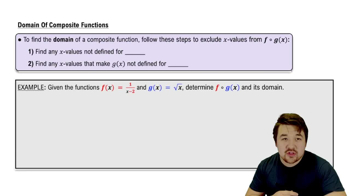
Domain Restrictions of Composed Functions

Properties of Real Numbers

These are fundamental rules governing operations with real numbers, including multiplication and division. Understanding these properties helps identify and justify equalities like the one given, ensuring the expression follows algebraic rules.
Recommended video:
03:31
Introduction to Complex Numbers