Ch. 8 - Sequences, Induction, and Probability
Blitzer - College Algebra 8th Edition
Blitzer8th EditionCollege AlgebraISBN: 9780136970514Not the one you use?Change textbook
Chapter 9, Problem 3

Evaluate the given binomial coefficient. (121)\(\binom{12}{1}\)

Verified step by step guidance
1
Identify the binomial coefficient notation: \(\binom{12}{1}\), which represents the number of ways to choose 1 item from 12 items.
Recall the formula for a binomial coefficient: \(\binom{n}{r} = \frac{n!}{r!(n-r)!}\), where \(n!\) denotes the factorial of \(n\).
Substitute \(n = 12\) and \(r = 1\) into the formula: \(\binom{12}{1} = \frac{12!}{1!(12-1)!}\).
Simplify the factorial expressions in the denominator: \$1! = 1\( and \)(12-1)! = 11!$, so the expression becomes \(\frac{12!}{1 \times 11!}\).
Recognize that \(\frac{12!}{11!} = 12\), so the binomial coefficient simplifies to \(12\).

Verified video answer for a similar problem:

This video solution was recommended by our tutors as helpful for the problem above.
Video duration:
2m
Was this helpful?

Key Concepts

Here are the essential concepts you must grasp in order to answer the question correctly.

Binomial Coefficient

The binomial coefficient, denoted as (n choose k), represents the number of ways to choose k elements from a set of n elements without regard to order. It is calculated using the formula n! / (k! (n-k)!), where '!' denotes factorial.
Recommended video:
Guided course
03:41
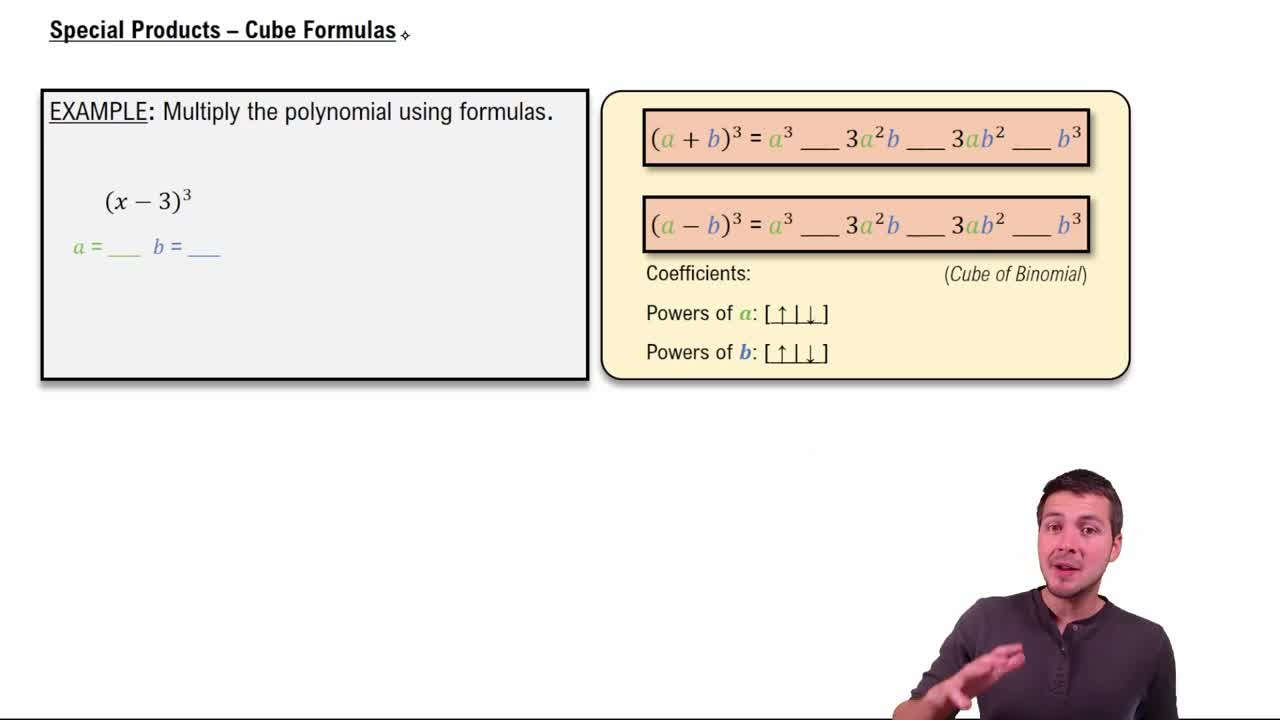
Special Products - Cube Formulas

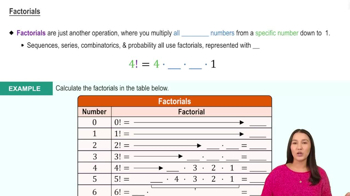
Factorial Function

The factorial of a non-negative integer n, written as n!, is the product of all positive integers less than or equal to n. For example, 5! = 5 × 4 × 3 × 2 × 1 = 120. Factorials are essential in calculating permutations and combinations.
Recommended video:
5:22
Factorials

Properties of Binomial Coefficients

Binomial coefficients have properties such as (n choose 0) = 1 and (n choose 1) = n. These properties simplify calculations, for instance, (12 choose 1) equals 12, since choosing one element from twelve can be done in twelve ways.
Recommended video:
5:36
Change of Base Property