Use the Rational Zero Theorem to list all possible rational zeros for each given function. f(x)=4x4−x3+5x2−2x−6
Table of contents
- 0. Review of Algebra4h 18m
- 1. Equations & Inequalities3h 18m
- 2. Graphs of Equations1h 43m
- 3. Functions2h 17m
- 4. Polynomial Functions1h 44m
- 5. Rational Functions1h 23m
- 6. Exponential & Logarithmic Functions2h 28m
- 7. Systems of Equations & Matrices4h 5m
- 8. Conic Sections2h 23m
- 9. Sequences, Series, & Induction1h 22m
- 10. Combinatorics & Probability1h 45m
4. Polynomial Functions
Zeros of Polynomial Functions
Problem 33b
Textbook Question
Show that each polynomial function has a real zero as described in parts (a) and (b). In Exercises 31 and 32, also work part (c). ƒ(x)=6x^4+13x^3-11x^2-3x+5 no zero less than -3
Verified step by step guidance1
First, understand that to show a polynomial function has a real zero in a certain interval, we can use the Intermediate Value Theorem. This theorem states that if a continuous function changes sign over an interval, then it must have at least one root (zero) in that interval.
Evaluate the polynomial function at the endpoints of the interval given. Here, since we want to show there is no zero less than -3, start by evaluating \(f(-3)\) and also consider values less than -3, for example \(f(-4)\) or \(f(-5)\).
Calculate \(f(-3) = 6(-3)^4 + 13(-3)^3 - 11(-3)^2 - 3(-3) + 5\) and similarly calculate \(f(-4)\) or \(f(-5)\) by substituting these values into the polynomial. Note the signs of these function values.
Check if the function values at these points change sign. If \(f(-3)\) and \(f(-4)\) (or \(f(-5)\)) have the same sign, then by the Intermediate Value Theorem, there is no zero between these points, meaning no zero less than -3.
Summarize your findings: if the function does not change sign for any values less than -3, then the polynomial has no real zeros less than -3, as required.
Verified video answer for a similar problem:This video solution was recommended by our tutors as helpful for the problem above
Video duration:
2mPlay a video:
Was this helpful?
Key Concepts
Here are the essential concepts you must grasp in order to answer the question correctly.
Polynomial Functions and Their Zeros
A polynomial function is an expression involving variables raised to whole-number exponents with coefficients. The zeros of a polynomial are the values of x for which the function equals zero. Understanding how to find and interpret these zeros is essential for analyzing the behavior of the polynomial.
Recommended video:
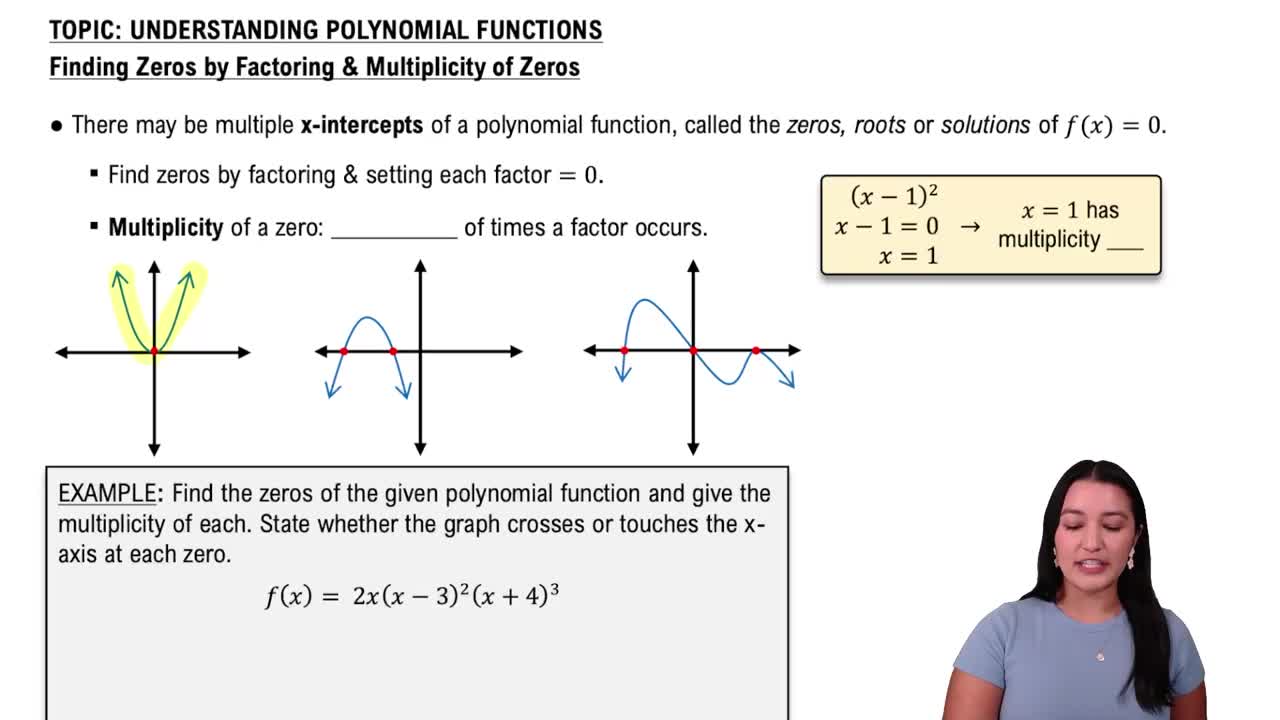
Finding Zeros & Their Multiplicity
Intermediate Value Theorem
The Intermediate Value Theorem states that if a continuous function changes sign over an interval, then it must have at least one zero within that interval. This theorem is useful for proving the existence of real zeros of polynomial functions on specific intervals.
Recommended video:
Introduction to Hyperbolas
Bounding Zeros of Polynomials
Bounding zeros involves determining intervals where zeros cannot exist, such as showing no zeros are less than a certain value. Techniques include evaluating the polynomial at boundary points and using sign analysis to restrict the location of zeros.
Recommended video:
Finding Zeros & Their Multiplicity
Related Videos
Related Practice
Textbook Question
357
views