Use the vertical line test to identify graphs in which y is a function of x.
Table of contents
- 0. Review of Algebra4h 18m
- 1. Equations & Inequalities3h 18m
- 2. Graphs of Equations1h 43m
- 3. Functions2h 17m
- 4. Polynomial Functions1h 44m
- 5. Rational Functions1h 23m
- 6. Exponential & Logarithmic Functions2h 28m
- 7. Systems of Equations & Matrices4h 5m
- 8. Conic Sections2h 23m
- 9. Sequences, Series, & Induction1h 22m
- 10. Combinatorics & Probability1h 45m
2. Graphs of Equations
Graphs and Coordinates
Problem 27b
Textbook Question
In Exercises 27–38, evaluate each function at the given values of the independent variable and simplify.f(x)=4x+5 b. f(x + 1)
Verified step by step guidance1
Step 1: Start with the given function f(x) = 4x + 5. This is a linear function where 'x' is the independent variable.
Step 2: Substitute (x + 1) into the function in place of 'x'. This means replacing every occurrence of 'x' in the function with (x + 1). The new expression becomes f(x + 1) = 4(x + 1) + 5.
Step 3: Apply the distributive property to simplify 4(x + 1). Multiply 4 by both 'x' and '1', resulting in 4x + 4.
Step 4: Combine like terms. Add the constant terms 4 and 5 together to simplify the expression further. This gives f(x + 1) = 4x + 9.
Step 5: The simplified expression for f(x + 1) is now f(x + 1) = 4x + 9. This is the final simplified form of the function evaluated at (x + 1).
Verified video answer for a similar problem:This video solution was recommended by our tutors as helpful for the problem above
Video duration:
1mPlay a video:
Was this helpful?
Key Concepts
Here are the essential concepts you must grasp in order to answer the question correctly.
Function Evaluation
Function evaluation involves substituting a specific value for the independent variable in a function. In this case, to evaluate f(x + 1), you replace x in the function f(x) = 4x + 5 with (x + 1). This process allows you to find the output of the function for a new input.
Recommended video:
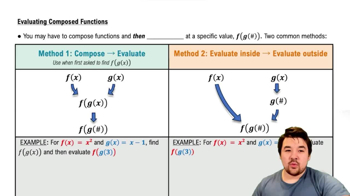
Evaluating Composed Functions
Algebraic Simplification
Algebraic simplification is the process of reducing an expression to its simplest form. After substituting x + 1 into the function, you will need to simplify the resulting expression, combining like terms and performing any necessary arithmetic operations to achieve a clearer representation of the function's output.
Recommended video:
Guided course
Introduction to Algebraic Expressions
Linear Functions
A linear function is a polynomial function of degree one, which can be expressed in the form f(x) = mx + b, where m is the slope and b is the y-intercept. The function f(x) = 4x + 5 is linear, indicating that its graph is a straight line. Understanding the properties of linear functions is essential for evaluating and interpreting their behavior.
Recommended video:
Linear Inequalities
Watch next
Master Graphs & the Rectangular Coordinate System with a bite sized video explanation from Patrick
Start learningRelated Videos
Related Practice
Textbook Question
1672
views