Pearson+ LogoPearson+ Logo
Ch. 1 - Equations and Inequalities
Blitzer - College Algebra 8th Edition
Blitzer8th EditionCollege AlgebraISBN: 9780136970514Not the one you use?Change textbook
Chapter 2, Problem 9

In Exercises 1–14, express each interval in set-builder notation and graph the interval on a number line. [- 3, ∞)

Verified step by step guidance
1
Identify the given interval: \([-3, \infty)\), which includes all real numbers starting from \(-3\) and extending to positive infinity.
Understand that the square bracket '[' means the endpoint \(-3\) is included in the interval, so \(x\) can be equal to \(-3\).
The parenthesis ')' next to \(\infty\) means infinity is not a number we can reach or include, but the interval extends indefinitely to the right.
Write the set-builder notation by describing all \(x\) such that \(x\) is greater than or equal to \(-3\): \(\{ x \mid x \geq -3 \}\).
To graph this on a number line, draw a solid dot at \(-3\) to show it is included, and shade the line to the right extending towards infinity.

Verified video answer for a similar problem:

This video solution was recommended by our tutors as helpful for the problem above.
Video duration:
1m
Was this helpful?

Key Concepts

Here are the essential concepts you must grasp in order to answer the question correctly.

Interval Notation

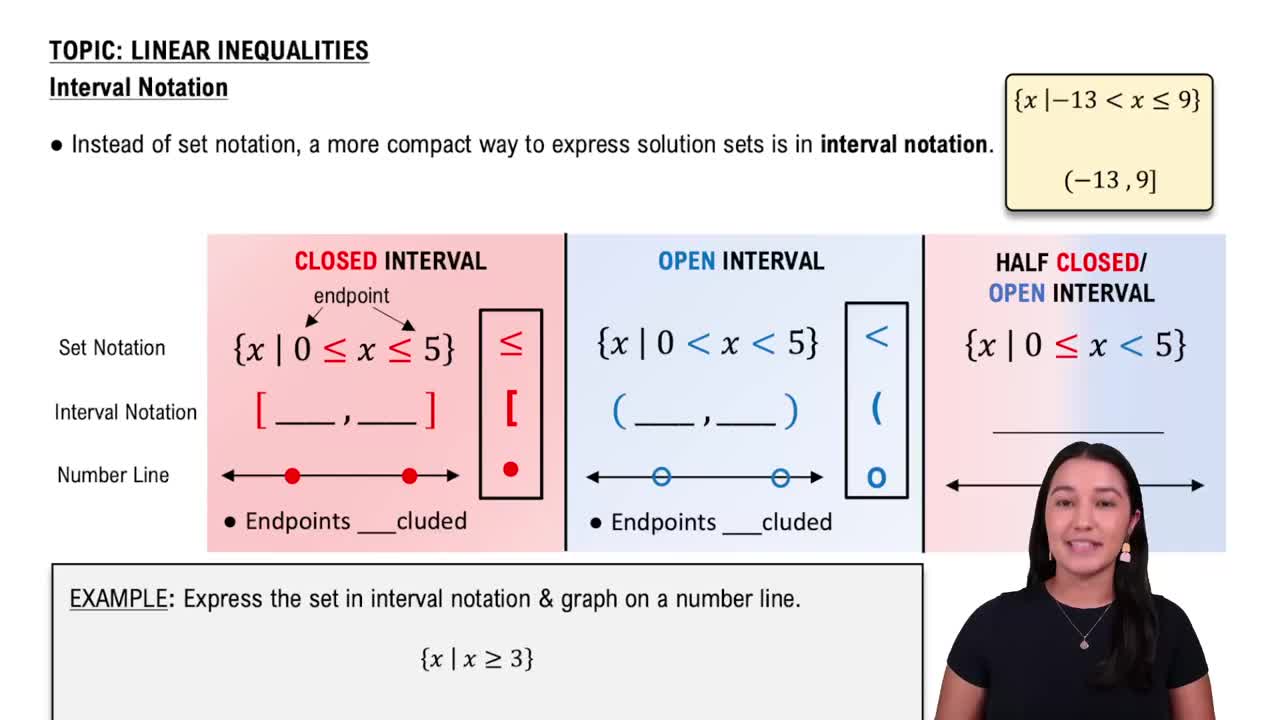
Interval notation is a way to represent a set of numbers between two endpoints. Square brackets [ ] indicate that an endpoint is included (closed interval), while parentheses ( ) mean the endpoint is excluded (open interval). For example, [-3, ∞) includes -3 and all numbers greater than -3.
Recommended video:
05:18
Interval Notation

Set-Builder Notation

Set-builder notation describes a set by specifying a property that its members satisfy. It uses a variable, a vertical bar or colon, and a condition, such as {x | x ≥ -3}, meaning the set of all x such that x is greater than or equal to -3.
Recommended video:
05:18
Interval Notation

Graphing Intervals on a Number Line

Graphing intervals involves shading the portion of the number line that represents the interval. Closed endpoints are shown with solid dots, indicating inclusion, while open endpoints use hollow dots. For [-3, ∞), a solid dot is placed at -3, and the line extends infinitely to the right.
Recommended video:
Guided course
02:35
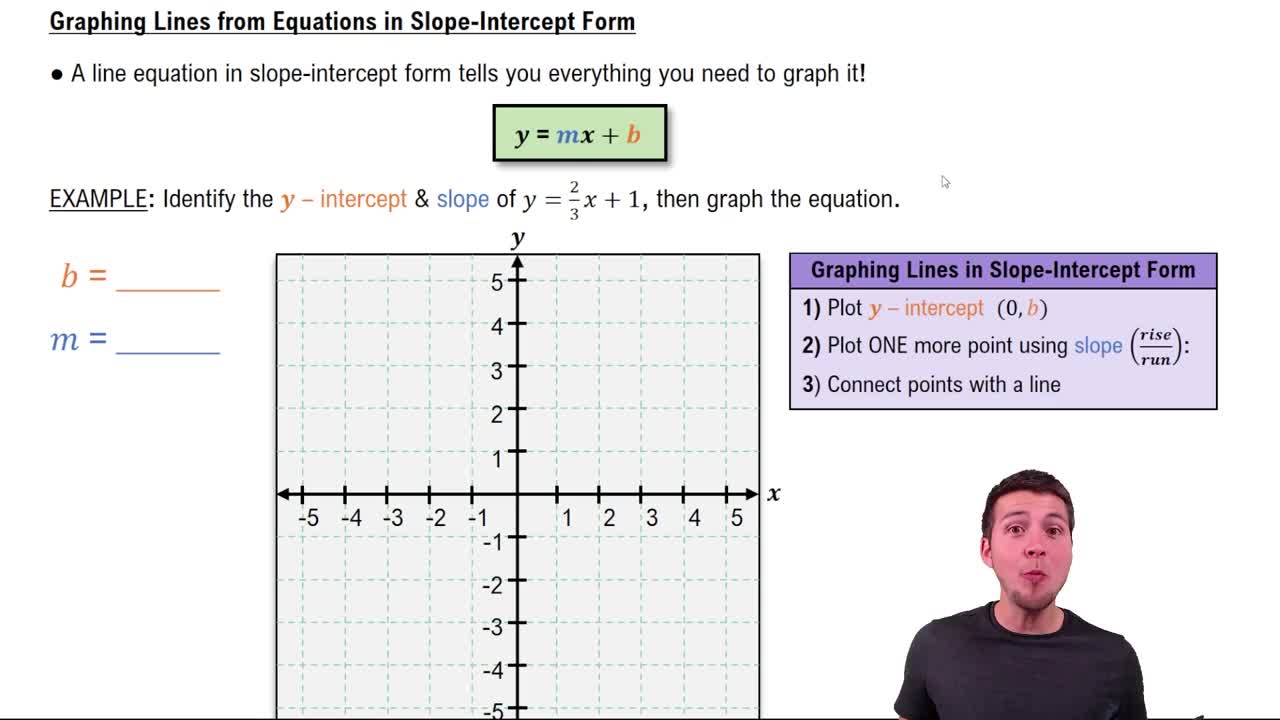
Graphing Lines in Slope-Intercept Form