Solve each problem. Use Descartes' rule of signs to determine the different possibilities for the numbers of positive, negative, and nonreal complex zeros of .
Ch. 3 - Polynomial and Rational Functions

Chapter 4, Problem 34
Graph each polynomial function. Factor first if the polynomial is not in factored form. ƒ(x)=x2(x-5)(x+3)(x-1)
Verified step by step guidance1
Identify the given polynomial function: \(f(x) = x^2 (x - 5)(x + 3)(x - 1)\).
Since the polynomial is already factored, note the roots by setting each factor equal to zero: \(x^2 = 0\), \(x - 5 = 0\), \(x + 3 = 0\), and \(x - 1 = 0\).
Solve each equation to find the zeros of the function: \(x = 0\) (with multiplicity 2), \(x = 5\), \(x = -3\), and \(x = 1\).
Determine the behavior of the graph at each zero, especially noting that \(x=0\) has multiplicity 2, which means the graph touches the x-axis and turns around at this point, while the other zeros with multiplicity 1 cross the x-axis.
Choose test points in each interval determined by the zeros to find the sign of \(f(x)\) in those intervals, then sketch the graph accordingly, considering the end behavior based on the leading term when the polynomial is expanded.

Verified video answer for a similar problem:
This video solution was recommended by our tutors as helpful for the problem above.
Video duration:
6mWas this helpful?
Key Concepts
Here are the essential concepts you must grasp in order to answer the question correctly.
Polynomial Functions
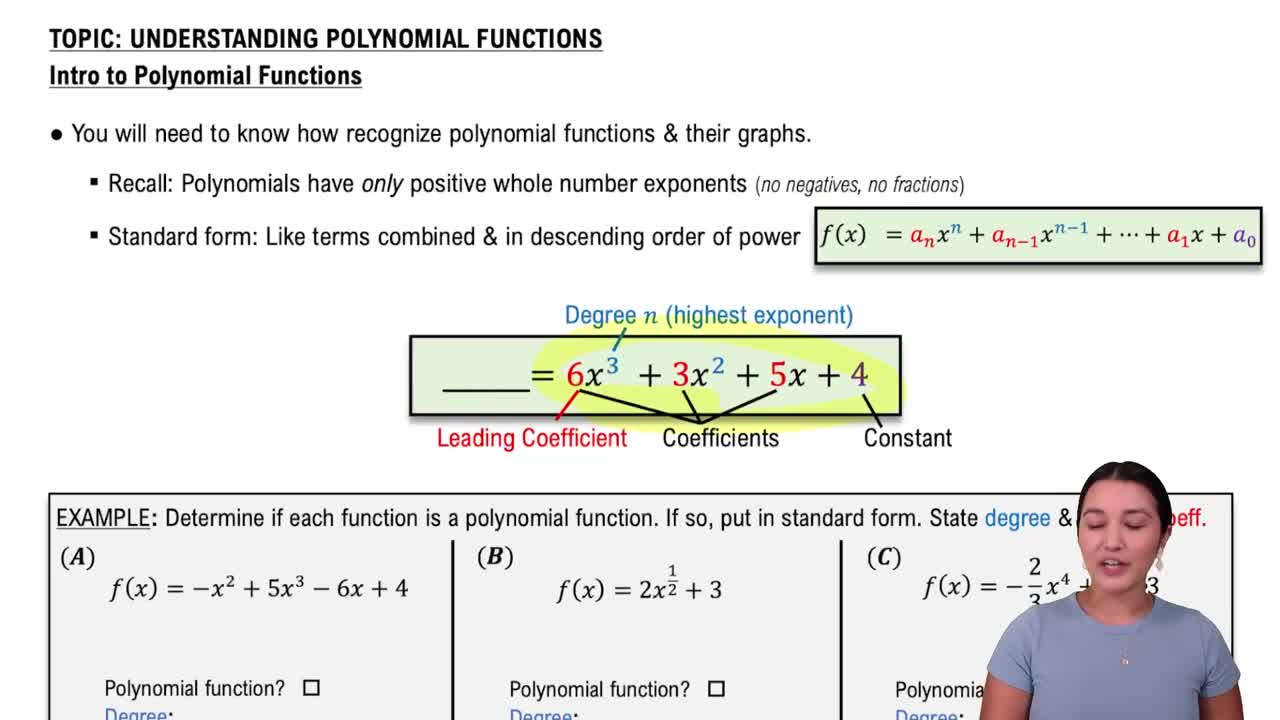
A polynomial function is an expression consisting of variables and coefficients combined using addition, subtraction, multiplication, and non-negative integer exponents. Understanding the degree and leading term helps predict the general shape and end behavior of the graph.
Recommended video:
Introduction to Polynomial Functions
Factoring Polynomials
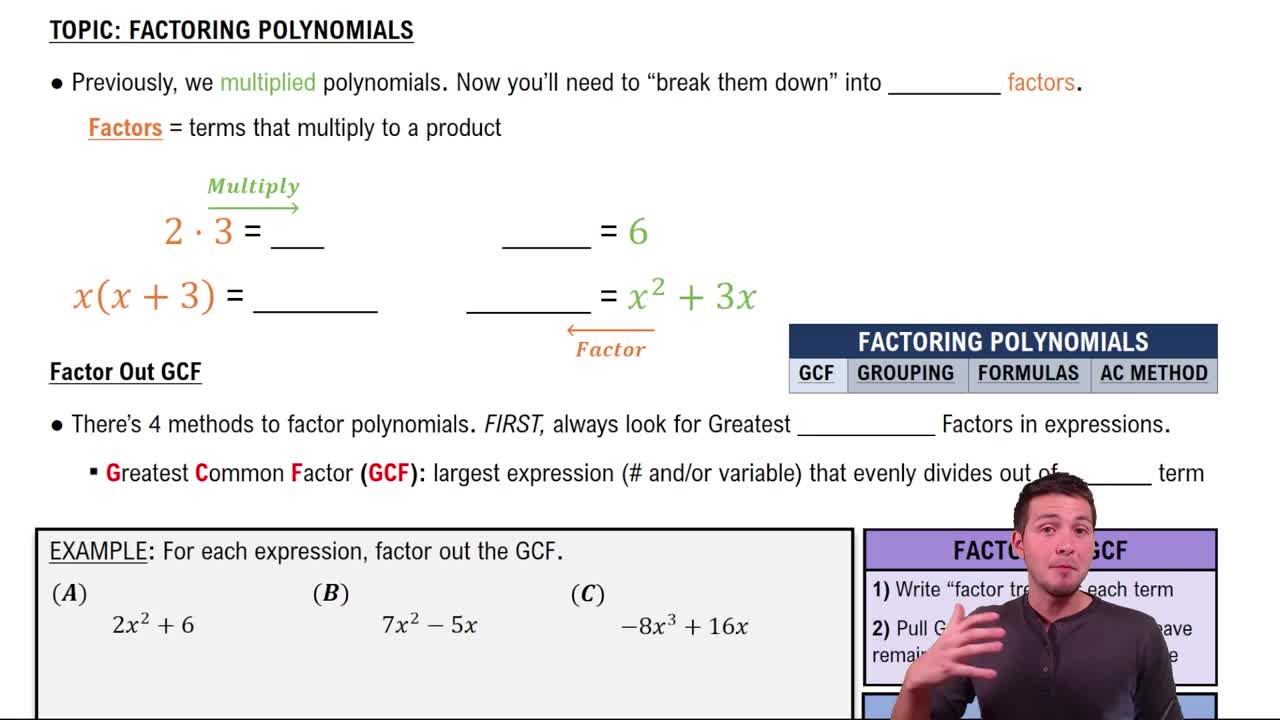
Factoring involves rewriting a polynomial as a product of simpler polynomials or factors. This process reveals the roots or zeros of the function, which correspond to the x-intercepts on the graph, making it easier to plot the function accurately.
Recommended video:
Guided course
Introduction to Factoring Polynomials
Graphing Polynomial Functions
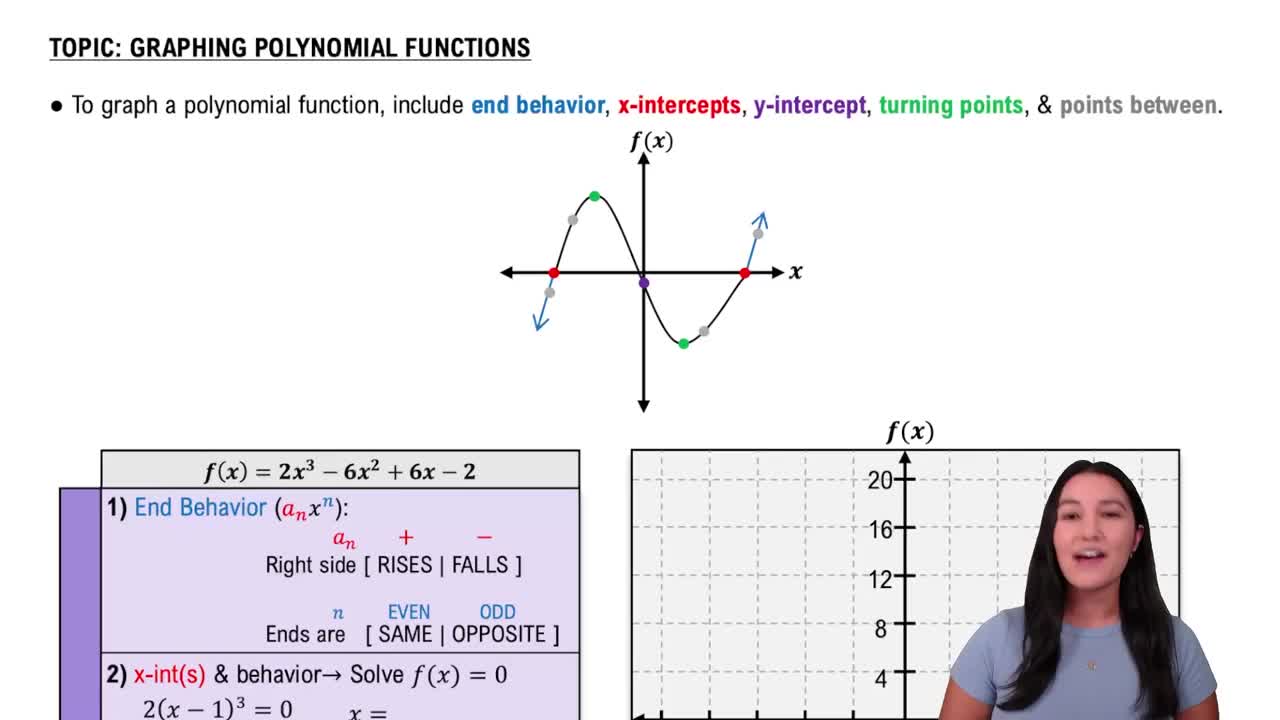
Graphing involves plotting key points such as zeros, determining the multiplicity of roots to understand the behavior at intercepts, and analyzing end behavior based on the leading term. This helps visualize the shape and important features of the polynomial.
Recommended video:
Graphing Polynomial Functions
Related Practice
Textbook Question
597
views
Textbook Question
Graph each polynomial function. Factor first if the polynomial is not in factored form. ƒ(x)=(3x-1)(x+2)2
977
views
Textbook Question
For each polynomial function, one zero is given. Find all other zeros.
573
views
Textbook Question
Graph each quadratic function. Give the (a) vertex, (b) axis, (c) domain, and (d) range. ƒ(x) = -3x2 + 24x - 46
1436
views
Textbook Question
Match the rational function in Column I with the appropriate description in Column II. Choices in Column II can be used only once. ƒ(x)=(x2+3x+4)/(x-5)
664
views
Textbook Question
Show that each polynomial function has a real zero as described in parts (a) and (b). In Exercises 31 and 32, also work part (c). ƒ(x)=6x^4+13x^3-11x^2-3x+5 no zero less than -3
420
views