Back
Back
Problem 34
Graph each polynomial function. Factor first if the polynomial is not in factored form. ƒ(x)=x2(x-5)(x+3)(x-1)
Problem 35
Graph each polynomial function. Factor first if the polynomial is not in factored form. ƒ(x)=(3x-1)(x+2)2
Problem 36
Graph each polynomial function. Factor first if the polynomial is not in factored form. ƒ(x)=(4x+3)(x+2)2
Problem 37
Graph each polynomial function. Factor first if the polynomial is not in factored form. ƒ(x)=x3+5x2-x-5
Problem 39
Graph each polynomial function. Factor first if the polynomial is not in factored form. ƒ(x)=-x3+x2+2x
Problem 41
Graph each polynomial function. Factor first if the polynomial is not in factored form. ƒ(x)=2x3(x2-4)(x-1)
Problem 43
Graph each polynomial function. Factor first if the polynomial is not in factored form. ƒ(x)=2x3-5x2-x+6
Problem 44
Graph each polynomial function. Factor first if the polynomial is not in factored form. ƒ(x)=2x4+x3-6x2-7x-2
Problem 45
Graph each polynomial function. Factor first if the polynomial is not in factored form. ƒ(x)=3x4-7x3-6x2+12x+8
Problem 46
Graph each polynomial function. Factor first if the polynomial is not in factored form. ƒ(x)=x4+3x3-3x2-11x-6
Problem 48
Use the intermediate value theorem to show that each polynomial function has a real zero between the numbers given. ƒ(x)=3x2-x-4; 1 and 2
Problem 49
Use the intermediate value theorem to show that each polynomial function has a real zero between the numbers given. ƒ(x)=-2x3+5x2+5x-7; 0 and 1
Problem 51
Use the intermediate value theorem to show that each polynomial function has a real zero between the numbers given. ƒ(x)=2x4-4x2+4x-8; 1 and 2
Problem 52
Use the intermediate value theorem to show that each polynomial function has a real zero between the numbers given. ƒ(x)=x4-4x3-x+3; 0.5 and 1
Problem 57
Show that the real zeros of each polynomial function satisfy the given conditions. ƒ(x)=x4-x3+3x2-8x+8; no real zero greater than 2
Problem 58
Show that the real zeros of each polynomial function satisfy the given conditions. ƒ(x)=2x5-x4+2x3-2x2+4x-4; no real zero greater than 1
Problem 59
Show that the real zeros of each polynomial function satisfy the given conditions. ƒ(x)=x4+x3-x2+3; no real zero less than -2
Problem 61
Show that the real zeros of each polynomial function satisfy the given conditions. ƒ(x)=3x4+2x3-4x2+x-1; no real zero greater than 1
Problem 63
Show that the real zeros of each polynomial function satisfy the given conditions. ƒ(x)=x5-3x3+x+2; no real zero greater than 2
Problem 65
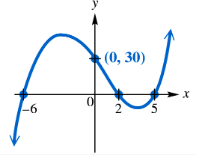
Find a polynomial function f of least degree having the graph shown. (Hint: See the NOTE following Example 4.)
Problem 69
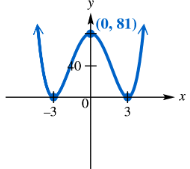
Find a polynomial function f of least degree having the graph shown. (Hint: See the NOTE following Example 4.)
Problem 83
Use a graphing calculator to find the coordinates of the turning points of the graph of each polynomial function in the given domain interval. Give answers to the nearest hundredth. ƒ(x)=2x3-5x2-x+1; [-1, 0]
Problem 85
Use a graphing calculator to find the coordinates of the turning points of the graph of each polynomial function in the given domain interval. Give answers to the nearest hundredth. ƒ(x)=2x3-5x2-x+1; [1.4, 2]
Problem 87
Use a graphing calculator to find the coordinates of the turning points of the graph of each polynomial function in the given domain interval. Give answers to the nearest hundredth. ƒ(x)=x3+4x2-8x-8; [-3.8, -3]
Problem 88
Use a graphing calculator to find the coordinates of the turning points of the graph of each polynomial function in the given domain interval. Give answers to the nearest hundredth. ƒ(x)=x4-7x3+13x2+6x-28; [-1, 0]
Problem 90
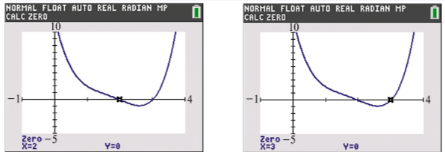
Solve each problem. A comprehensive graph of ƒ(x)=x4-7x3+18x2-22x+12 is shown in the two screens, along with displays of the two real zeros. Find the two remaining nonreal complex zeros.
Problem 5
Provide a short answer to each question. What is the equation of the vertical asymptote of the graph of y=[1/(x-3)]+2? Of the horizontal asymptote?
Problem 7
Provide a short answer to each question. Is ƒ(x)=1/x2 an even or an odd function? What symmetry does its graph exhibit?
Problem 8
Provide a short answer to each question. Is ƒ(x)=1/x an even or an odd function? What symmetry does its graph exhibit?
Problem 9
Use the graphs of the rational functions in choices A–D to answer each question.
There may be more than one correct choice. Which choices have domain (-∞, 3)U(3, ∞)?