Exercises 107–109 will help you prepare for the material covered in the next section. Factor: x3+3x2−x−3
Table of contents
- 0. Review of Algebra4h 18m
- 1. Equations & Inequalities3h 18m
- 2. Graphs of Equations1h 43m
- 3. Functions2h 17m
- 4. Polynomial Functions1h 44m
- 5. Rational Functions1h 23m
- 6. Exponential & Logarithmic Functions2h 28m
- 7. Systems of Equations & Matrices4h 5m
- 8. Conic Sections2h 23m
- 9. Sequences, Series, & Induction1h 22m
- 10. Combinatorics & Probability1h 45m
4. Polynomial Functions
Understanding Polynomial Functions
Problem 34
Textbook Question
Graph each polynomial function. Factor first if the polynomial is not in factored form. See Examples 3 and 4. ƒ(x)=x^2(x-5)(x+3)(x-1)
Verified step by step guidance1
Identify the polynomial function: \( f(x) = x^2(x-5)(x+3)(x-1) \).
Recognize that the polynomial is already in factored form.
Determine the roots of the polynomial by setting each factor equal to zero: \( x^2 = 0 \), \( x-5 = 0 \), \( x+3 = 0 \), and \( x-1 = 0 \).
Find the x-intercepts from the roots: \( x = 0 \), \( x = 5 \), \( x = -3 \), and \( x = 1 \).
Analyze the multiplicity of each root to determine the behavior of the graph at each intercept: \( x = 0 \) has multiplicity 2 (touches the x-axis), \( x = 5 \), \( x = -3 \), and \( x = 1 \) have multiplicity 1 (crosses the x-axis).
Verified video answer for a similar problem:This video solution was recommended by our tutors as helpful for the problem above
Video duration:
6mPlay a video:
Was this helpful?
Key Concepts
Here are the essential concepts you must grasp in order to answer the question correctly.
Polynomial Functions
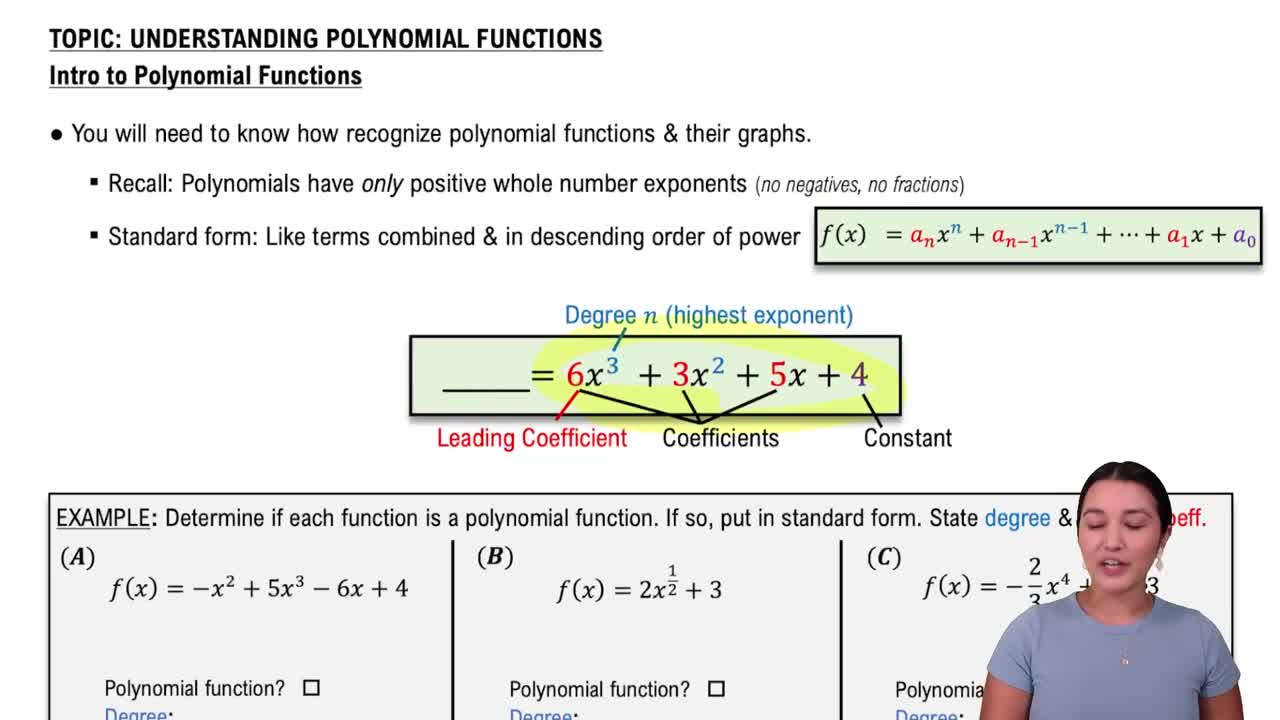
A polynomial function is a mathematical expression involving a sum of powers in one or more variables multiplied by coefficients. The general form of a polynomial in one variable is f(x) = a_n*x^n + a_(n-1)*x^(n-1) + ... + a_1*x + a_0, where 'n' is a non-negative integer and 'a_n' are constants. Understanding the structure of polynomial functions is essential for graphing them accurately.
Recommended video:
Introduction to Polynomial Functions
Factoring Polynomials
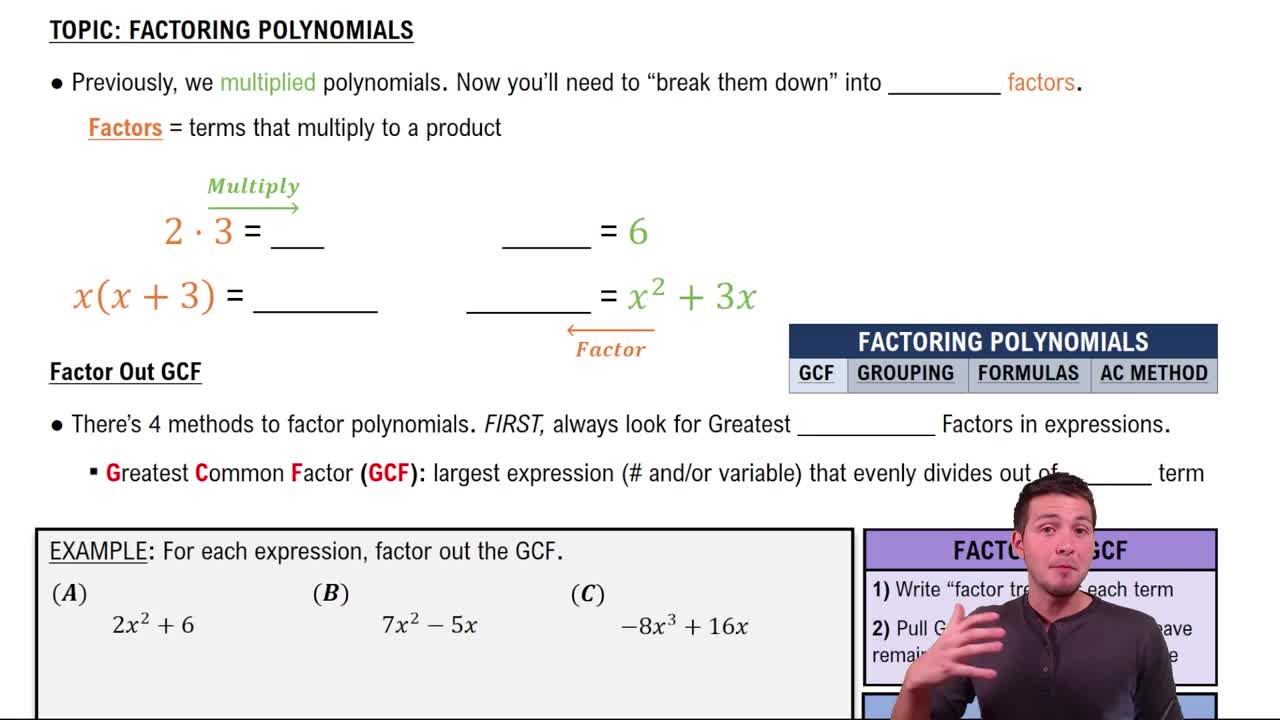
Factoring a polynomial involves expressing it as a product of its simpler polynomial factors. This process is crucial for simplifying the polynomial and making it easier to analyze its roots and behavior. For example, the polynomial f(x) = x^2(x-5)(x+3)(x-1) is already factored, which allows for straightforward identification of its zeros and helps in graphing.
Recommended video:
Guided course
Introduction to Factoring Polynomials
Graphing Polynomial Functions
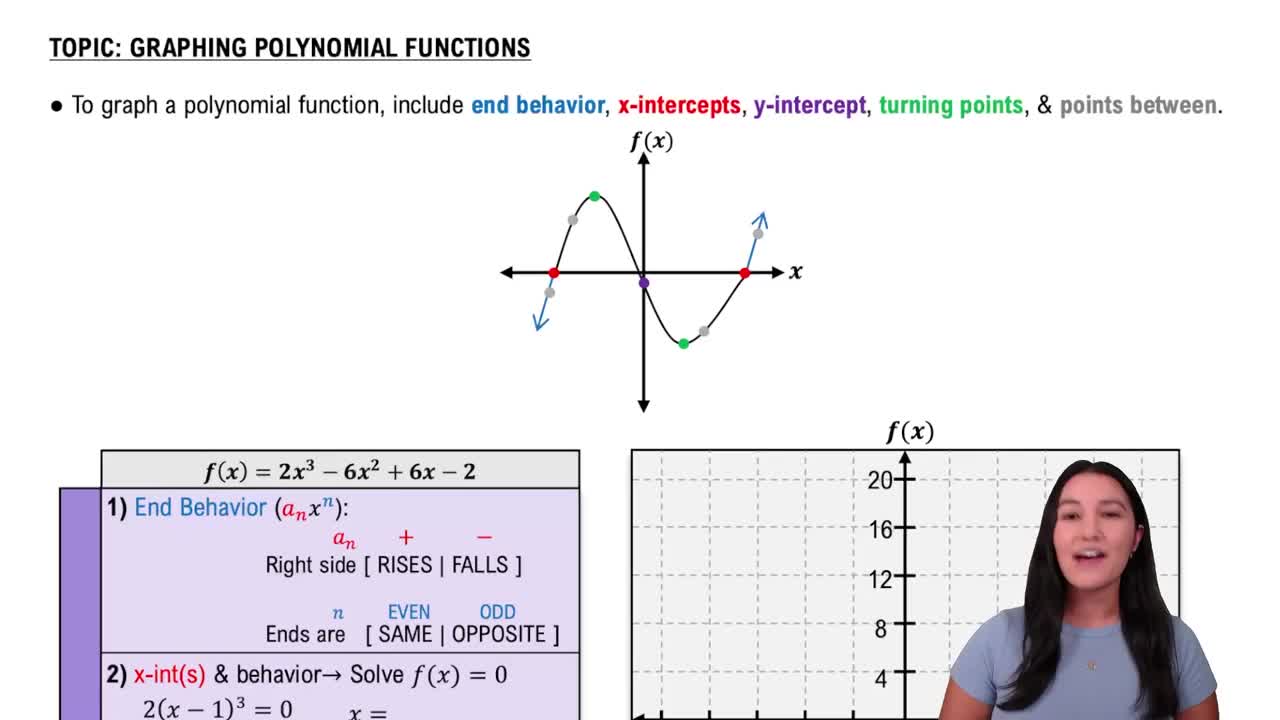
Graphing polynomial functions requires understanding their key features, such as intercepts, end behavior, and turning points. The roots of the polynomial, found from its factored form, indicate where the graph intersects the x-axis. Additionally, the degree of the polynomial determines the number of turning points and the overall shape of the graph, which is essential for accurate representation.
Recommended video:
Graphing Polynomial Functions
Watch next
Master Introduction to Polynomial Functions with a bite sized video explanation from Patrick
Start learningRelated Videos
Related Practice
Textbook Question
667
views