Rewrite 4-5x-x2+6x3 in descending powers of x.
Table of contents
- 0. Review of Algebra4h 18m
- 1. Equations & Inequalities3h 18m
- 2. Graphs of Equations1h 43m
- 3. Functions2h 17m
- 4. Polynomial Functions1h 44m
- 5. Rational Functions1h 23m
- 6. Exponential & Logarithmic Functions2h 28m
- 7. Systems of Equations & Matrices4h 5m
- 8. Conic Sections2h 23m
- 9. Sequences, Series, & Induction1h 22m
- 10. Combinatorics & Probability1h 45m
4. Polynomial Functions
Understanding Polynomial Functions
Problem 90
Textbook Question
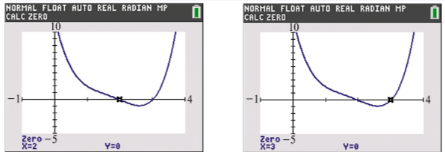
Solve each problem. A comprehensive graph of ƒ(x)=x^4-7x^3+18x^2-22x+12 is shown in the two screens, along with displays of the two real zeros. Find the two remaining nonreal complex zeros.
Verified step by step guidance1
Identify the given polynomial function: \( f(x) = x^4 - 7x^3 + 18x^2 - 22x + 12 \).
Recognize that the polynomial is of degree 4, which means it has 4 roots (real or complex).
Note that the problem states there are two real zeros, so the remaining two zeros must be nonreal complex numbers.
Use the fact that complex roots of polynomials with real coefficients come in conjugate pairs. Therefore, if \( a + bi \) is a root, \( a - bi \) is also a root.
Apply the Fundamental Theorem of Algebra and the Conjugate Root Theorem to find the two nonreal complex zeros, considering the given real zeros and the degree of the polynomial.
Verified video answer for a similar problem:This video solution was recommended by our tutors as helpful for the problem above
Video duration:
7mPlay a video:
Was this helpful?
Key Concepts
Here are the essential concepts you must grasp in order to answer the question correctly.
Polynomial Functions
A polynomial function is a mathematical expression involving a sum of powers in one or more variables multiplied by coefficients. In this case, ƒ(x) = x^4 - 7x^3 + 18x^2 - 22x + 12 is a fourth-degree polynomial, which can have up to four roots (zeros). Understanding the behavior of polynomial functions, including their degree and leading coefficient, is essential for analyzing their graphs and finding their zeros.
Recommended video:
Introduction to Polynomial Functions
Complex Zeros
Complex zeros are solutions to polynomial equations that are not real numbers. They occur in conjugate pairs due to the Fundamental Theorem of Algebra, which states that a polynomial of degree n has exactly n roots in the complex number system. Identifying complex zeros involves recognizing that if a polynomial has real coefficients, any nonreal zeros must appear as pairs of the form a + bi and a - bi, where a and b are real numbers.
Recommended video:
Complex Conjugates
Graphical Interpretation of Zeros
The zeros of a polynomial function correspond to the x-intercepts of its graph. By analyzing the graph of ƒ(x), one can visually identify the real zeros and infer the presence of complex zeros when the graph does not intersect the x-axis at certain points. Understanding how to interpret the graph helps in determining the nature and number of zeros, including distinguishing between real and complex solutions.
Recommended video:
Finding Zeros & Their Multiplicity
Watch next
Master Introduction to Polynomial Functions with a bite sized video explanation from Patrick
Start learningRelated Videos
Related Practice
Textbook Question
730
views