The value of the euro was recently \$1.15 U.S., and the price of 1 liter of gasoline in France is 1.42 euro. What is the price of 1 gallon of gasoline in U.S. dollars in France?
Ch.1 - Matter, Measurement & Problem Solving
Chapter 1, Problem 113
Do each calculation without your calculator and give the answers to the correct number of significant figures: a. 1.76 * 10^3 > 8.0 * 10^2 b. 1.87 * 10^-2 + 2 * 10^-4 - 3.0 * 10^-3 c. [(1.36 * 10^5)(0.000322) > 0.082](129.2)
Verified step by step guidance1
Step 1: For part (a), identify the number of significant figures in each number. 1.76 * 10^3 has three significant figures, and 8.0 * 10^2 has two significant figures.
Step 2: Perform the division in part (a) without a calculator. Divide the coefficients (1.76 by 8.0) and subtract the exponents of 10 (3 - 2).
Step 3: For part (b), align the numbers by their exponents. Convert 1.87 * 10^-2, 2 * 10^-4, and 3.0 * 10^-3 to the same power of ten if necessary.
Step 4: Add and subtract the coefficients in part (b) while keeping track of the significant figures. The result should have the same number of decimal places as the number with the least decimal places.
Step 5: For part (c), first perform the multiplication inside the brackets. Multiply 1.36 * 10^5 by 0.000322, then divide by 0.082. Finally, multiply the result by 129.2, ensuring the final answer has the correct number of significant figures.
Key Concepts
Here are the essential concepts you must grasp in order to answer the question correctly.
Significant Figures
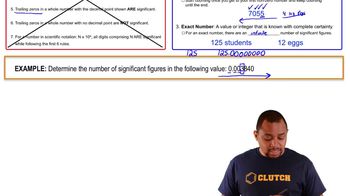
Significant figures are the digits in a number that contribute to its precision. This includes all non-zero digits, any zeros between significant digits, and trailing zeros in the decimal portion. Understanding significant figures is crucial for reporting measurements accurately, as it reflects the precision of the data and ensures that calculations maintain this precision.
Recommended video:
Guided course
Significant Figures Example
Scientific Notation
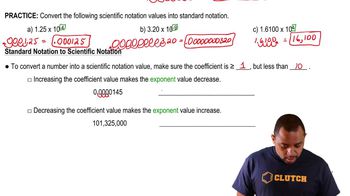
Scientific notation is a way of expressing numbers that are too large or too small to be conveniently written in decimal form. It is represented as a product of a number between 1 and 10 and a power of ten. This notation simplifies calculations, especially when dealing with very large or very small values, making it easier to perform arithmetic operations while maintaining significant figures.
Recommended video:
Guided course
Standard Notation to Scientific Notation
Order of Operations
The order of operations is a set of rules that dictates the sequence in which calculations should be performed to ensure consistent results. The common acronym PEMDAS (Parentheses, Exponents, Multiplication and Division, Addition and Subtraction) helps remember this order. Applying these rules correctly is essential for solving mathematical expressions accurately, especially when combining different operations.
Related Practice
Textbook Question
764
views
Textbook Question
The proton has a radius of approximately 1.0×10⁻¹³ cm and a mass of 1.7×10⁻²⁴ g. Determine the density of a proton for a sphere V = (4/3)πr3.
3418
views
Textbook Question
Classify each property as intensive or extensive. a. volume b. boiling point c. temperature d. electrical conductivity e. energy
921
views
Textbook Question
A thief uses a can of sand to replace a solid gold cylinder that sits on a weight-sensitive, alarmed pedestal. The can of sand and the gold cylinder have exactly the same dimensions (length = 22 and radius = 3.8 cm). a. Calculate the mass of each cylinder (ignore the mass of the can itself). (density of gold = 19.3 g/cm3, density of sand = 3.00 g/cm3) b. Does the thief set off the alarm? Explain.
742
views