An ethylene glycol solution contains 21.2 g of ethylene glycol (C2H6O2) in 85.4 mL of water. Determine the freezing point and boiling point of the solution. (Assume a density of 1.00 g/mL for water.)
Verified step by step guidance
1
Calculate the molality of the solution by first determining the moles of ethylene glycol (C_2H_6O_2) using its molar mass.
Convert the volume of water to mass using the given density (1.00 g/mL), then use this mass to calculate the molality of the solution.
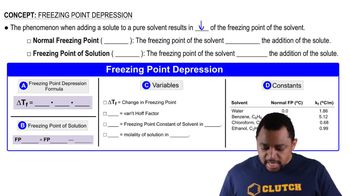
Use the freezing point depression formula, \( \Delta T_f = i \cdot K_f \cdot m \), where \( i \) is the van't Hoff factor (1 for ethylene glycol), \( K_f \) is the freezing point depression constant for water, and \( m \) is the molality.
Calculate the new freezing point by subtracting \( \Delta T_f \) from the normal freezing point of water (0°C).
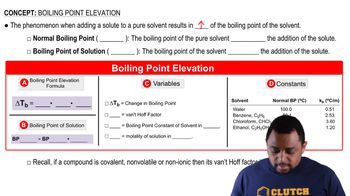
Use the boiling point elevation formula, \( \Delta T_b = i \cdot K_b \cdot m \), where \( K_b \) is the boiling point elevation constant for water, to find the change in boiling point, and add \( \Delta T_b \) to the normal boiling point of water (100°C).
Key Concepts
Here are the essential concepts you must grasp in order to answer the question correctly.
Colligative Properties
Colligative properties are physical properties of solutions that depend on the number of solute particles in a given amount of solvent, rather than the identity of the solute. These properties include boiling point elevation and freezing point depression, which are crucial for determining how the presence of a solute like ethylene glycol affects the freezing and boiling points of water.
Freezing point depression is a colligative property that describes the lowering of the freezing point of a solvent when a solute is added. The extent of this depression can be calculated using the formula ΔTf = i * Kf * m, where ΔTf is the change in freezing point, Kf is the freezing point depression constant of the solvent, and m is the molality of the solution.
Boiling point elevation is another colligative property that indicates the increase in the boiling point of a solvent when a solute is dissolved in it. This can be calculated using the formula ΔTb = i * Kb * m, where ΔTb is the change in boiling point, Kb is the boiling point elevation constant of the solvent, and m is the molality of the solution. Understanding this concept is essential for determining how the boiling point of water changes in the presence of ethylene glycol.


 Verified step by step guidance
 01:26
01:26