
It is common to study the biology and genetics of bacteria, yeast, fruit flies, and mice to understand biological and genetic processes in humans. Why do you think this is the case?
Verified step by step guidance
1
insert step 1> Understand that model organisms like bacteria, yeast, fruit flies, and mice are used in genetic research because they share many biological and genetic similarities with humans.
insert step 2> Recognize that these organisms have simpler systems, making it easier to study complex biological processes.
insert step 3> Note that these organisms have short life cycles and reproduce quickly, allowing for the observation of multiple generations in a short period.
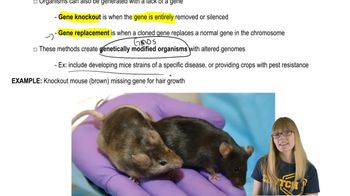
insert step 4> Consider that these organisms are often easier to manipulate genetically, enabling researchers to study the effects of specific genes.
insert step 5> Acknowledge that findings in these model organisms can often be extrapolated to understand human biology and disease, due to the conservation of many genetic pathways.
Verified video answer for a similar problem:
This video solution was recommended by our tutors as helpful for the problem above
Video duration:
1m
Play a video:
Was this helpful?
Key Concepts
Here are the essential concepts you must grasp in order to answer the question correctly.
Model Organisms
Model organisms are species that are extensively studied to understand biological processes due to their simpler systems, short life cycles, and genetic similarities to humans. Examples include fruit flies (Drosophila melanogaster) and mice (Mus musculus), which allow researchers to investigate genetic functions and disease mechanisms that can be extrapolated to human biology.
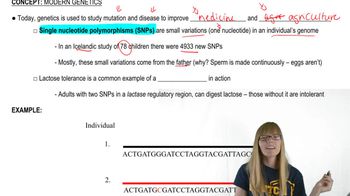
Genetic homology refers to the similarity in DNA sequences between different species, indicating a common ancestry. This concept is crucial in genetics as it allows scientists to use findings from model organisms to infer functions of human genes, facilitating the understanding of genetic diseases and potential treatments.
Experimental manipulation involves altering the genetic makeup of model organisms to observe the effects on biological processes. Techniques such as CRISPR gene editing enable researchers to create specific mutations, helping to elucidate gene function and the underlying mechanisms of diseases, which can be relevant to human health.