
Pearson+ LogoPearson+ Logo
Ch. 6 - Genetic Analysis and Mapping in Bacteria and Bacteriophages
Sanders - Genetic Analysis: An Integrated Approach 3rd Edition
Sanders3rd EditionGenetic Analysis: An Integrated ApproachISBN: 9780135564172Not the one you use?Change textbook
Chapter 6, Problem 27

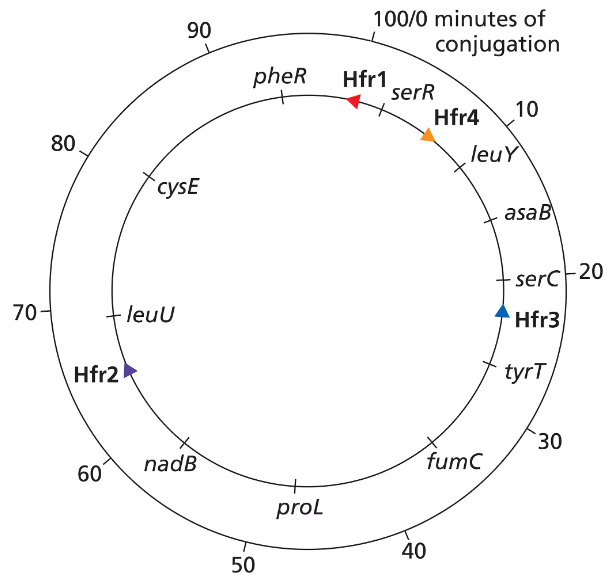
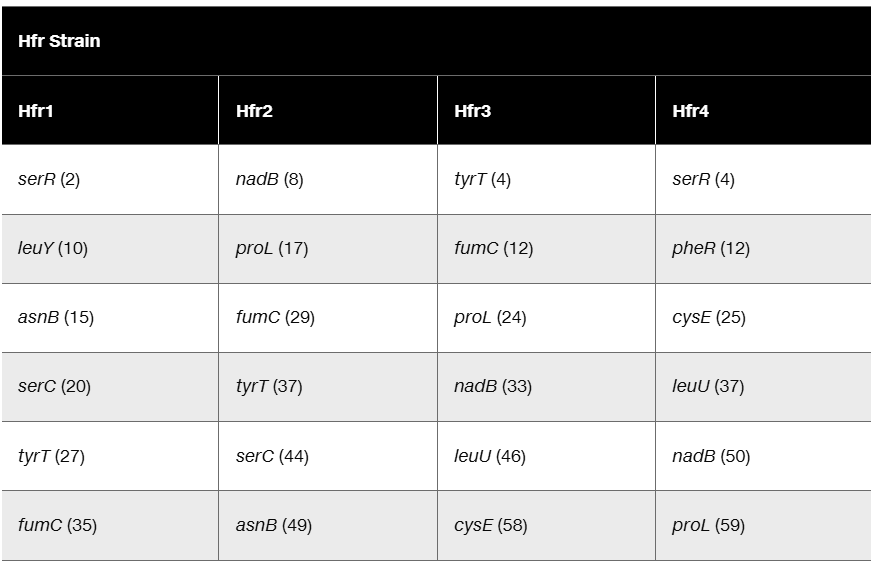
Look closely at the consolidated Hfr map and the data used to build the map on page 261. Suppose a fifth Hfr strain had the F factor inserted exactly halfway between cysE and leuU and had an orientation that was the same as that of Hfr 1. List the order of gene transfer for the first six genes transferred by this Hfr and the number of minutes of conjugation at which each gene is expected to be seen.


Table displaying gene transfer order and timing for four Hfr strains in bacterial conjugation.

Verified step by step guidance
1
Examine the consolidated Hfr map and identify the relative positions of the genes, including cysE and leuU. Note that the F factor is inserted halfway between these two genes in the new Hfr strain.
Determine the orientation of the F factor in the new Hfr strain. Since the problem states that the orientation is the same as Hfr 1, the direction of gene transfer will follow the same sequence as Hfr 1.
Starting from the insertion point (halfway between cysE and leuU), list the order of genes that will be transferred. The transfer will proceed in the direction of the F factor's orientation, moving sequentially around the circular chromosome.
Using the table provided, calculate the time at which each gene will be transferred. The transfer time for each gene is determined by its distance from the insertion point, with the first gene transferred at 0 minutes and subsequent genes at intervals based on their relative positions.
List the first six genes transferred and their corresponding transfer times in minutes. Ensure that the order and timing are consistent with the map and the orientation of the F factor.

Verified video answer for a similar problem:

This video solution was recommended by our tutors as helpful for the problem above.
Video duration:
1m
Was this helpful?

Key Concepts

Here are the essential concepts you must grasp in order to answer the question correctly.

Hfr Strains

Hfr (high frequency of recombination) strains are bacterial strains that have the F factor integrated into their chromosome. This integration allows them to transfer chromosomal genes to a recipient bacterium during conjugation. The order of gene transfer is determined by the position of the F factor insertion and the direction of transfer, which is crucial for understanding genetic mapping and gene linkage.
Recommended video:
Guided course
08:52
F Factor and Hfr

Gene Transfer Order

The gene transfer order refers to the sequence in which genes are transferred from the Hfr strain to the recipient during bacterial conjugation. This order is influenced by the physical location of genes on the chromosome and the time it takes for each gene to be transferred, which is measured in minutes. Understanding this order is essential for predicting which genes will be transferred first and for constructing genetic maps.
Recommended video:
Guided course
09:09
Mapping Genes

Conjugation Timing

Conjugation timing is the duration required for the transfer of specific genes during bacterial conjugation. Each gene has a characteristic transfer time, which can be used to estimate when a gene will be received by the recipient cell. This timing is critical for mapping the relative positions of genes on the chromosome and for understanding the dynamics of genetic exchange in bacteria.
Recommended video:
Guided course
04:06
Conjugation Overview