Pearson+ LogoPearson+ Logo
Ch. 6 - Genetic Analysis and Mapping in Bacteria and Bacteriophages
Sanders - Genetic Analysis: An Integrated Approach 3rd Edition
Sanders3rd EditionGenetic Analysis: An Integrated ApproachISBN: 9780135564172Not the one you use?Change textbook
Chapter 6, Problem 28

Fifty bacterial colonies are on a complete-medium growth plate. The colonies are replica plated to a minimal-medium plate, and 46 colonies grow. What can you say about the bacteria from the four colonies that do not grow? Design an experiment and describe the methods you would use to determine if any of these four colonies are leu⁻, arg⁻, or val⁻.

Verified step by step guidance
1
Identify the missing nutrients: The four colonies that do not grow on the minimal-medium plate likely have mutations that prevent them from synthesizing certain essential nutrients, such as leucine (leu), arginine (arg), or valine (val).
Design a supplementation experiment: Prepare three separate minimal-medium plates, each supplemented with one of the nutrients (leucine, arginine, or valine).
Replica plate the non-growing colonies: Transfer the four non-growing colonies from the original minimal-medium plate to each of the three supplemented plates.
Observe growth patterns: Check which colonies grow on each of the supplemented plates. Growth on a specific plate indicates that the colony is auxotrophic for the nutrient that was supplemented.
Analyze results: Determine the specific nutrient requirement for each of the four colonies based on their growth patterns on the supplemented plates.

Verified video answer for a similar problem:

This video solution was recommended by our tutors as helpful for the problem above.
Video duration:
2m
Was this helpful?

Key Concepts

Here are the essential concepts you must grasp in order to answer the question correctly.

Replica Plating

Replica plating is a technique used to transfer bacterial colonies from one growth medium to another, allowing researchers to assess the growth capabilities of the bacteria under different nutritional conditions. This method helps identify auxotrophic mutants, which require specific nutrients not present in minimal media for growth.
Recommended video:
Guided course
09:06
Meiosis Steps

Auxotrophy

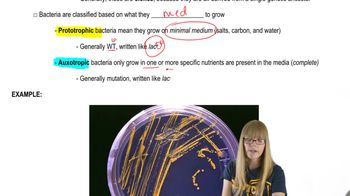
Auxotrophy refers to the inability of an organism to synthesize a particular compound required for its growth, often due to mutations in genes involved in metabolic pathways. In this context, leu⁻, arg⁻, and val⁻ indicate that the bacteria cannot synthesize leucine, arginine, and valine, respectively, and thus require these amino acids from the environment to grow.
Recommended video:
Guided course
09:35
Bacteria in the Laboratory

Minimal Medium

Minimal medium is a growth medium that contains only the essential nutrients required for the growth of wild-type bacteria, typically including a carbon source, salts, and water. It lacks additional growth factors, making it useful for identifying auxotrophic mutants, as only those bacteria that can synthesize all necessary compounds will grow.
Recommended video:
Guided course
04:06
Conjugation Overview