The following figure illustrates reciprocal crosses involving chickens with sex-linked dominant barred mutation. For Cross A and for Cross B, cross the F₁ roosters and hens and predict the feather patterns of roosters and hens in the F2.

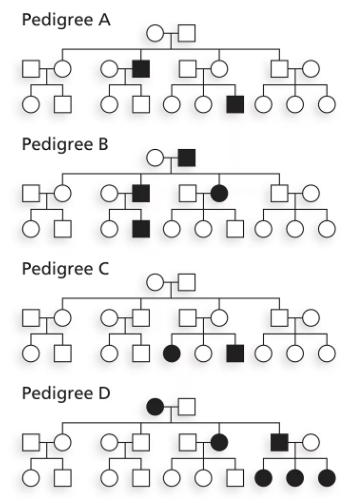
For each pedigree shown,

Identify which pattern(s) of transmission is/are impossible. Specify why transmission is impossible.
Verified step by step guidance
Verified video answer for a similar problem:
Key Concepts
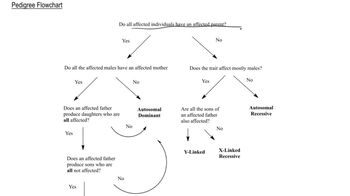
Pedigree Analysis
Modes of Inheritance
Genetic Consanguinity
In fruit flies, yellow body (y) is recessive to gray body , and the trait of body color is inherited on the X chromosome. Vestigial wing (v) is recessive to full-sized wing (v⁺), and the trait has autosomal inheritance. A cross of a male with yellow body and full wings to a female with gray body and full wings is made. Based on an analysis of the progeny of the cross shown below, determine the genotypes of parental and progeny flies.
[Table below appears at this point containing crosses and results]
For each pedigree shown,
Identify which simple pattern of hereditary transmission (autosomal dominant, autosomal recessive, X-linked dominant, or X-linked recessive) is most likely to have occurred. Give genotypes for individuals involved in transmitting the trait.
Use the blank pedigrees provided to depict transmission of
(a) an X-linked recessive trait and
(b) an X-linked dominant trait, by filling in circles and squares to represent individuals with the trait of interest. Give genotypes for each person in each pedigree.
Carefully design each transmission pattern so that pedigree
(a) cannot be confused with autosomal recessive transmission and pedigree
(b) cannot be confused with autosomal dominant transmission. Identify the transmission events that eliminate the possibility of autosomal transmission for each pedigree.
For each pedigree shown,
Determine which other pattern(s) of transmission is/are possible. For each possible mode of transmission, specify the genotypes necessary for transmission to occur.
Four eye-color mutants in Drosophila—apricot, brown, carnation, and purple—are inherited as recessive traits. Red is the dominant wild-type color of fruit-fly eyes. Eight crosses (A through H) are made between parents from pure-breeding lines.
Predict F2 phenotype ratios of crosses A, B, D, and G.