Skip to main content
Genetics
My Course
Learn
Exam Prep
AI Tutor
Study Guides
Textbook Solutions
Flashcards
Explore
Try the app
My Course
Learn
Exam Prep
AI Tutor
Study Guides
Textbook Solutions
Flashcards
Explore
Try the app
Back
Hardy Weinberg definitions
You can tap to flip the card.
Hardy Weinberg Principle
You can tap to flip the card.
👆
Hardy Weinberg Principle
A theoretical framework for predicting allele and genotype frequencies in a population under idealized conditions.
Track progress
Control buttons has been changed to "navigation" mode.
1/15
Related flashcards
Related practice
Recommended videos
Hardy Weinberg quiz #1
Hardy Weinberg
16 Terms
Hardy Weinberg
21. Population Genetics
7 problems
Topic
Kylia
Allelic Frequency Changes
21. Population Genetics
7 problems
Topic
Kylia
21. Population Genetics
2 topics
6 problems
Chapter
Kylia
Guided course
13:04
Hardy Weinberg
2043
views
31
rank
4
comments
Terms in this set (15)
Hide definitions
Hardy Weinberg Principle
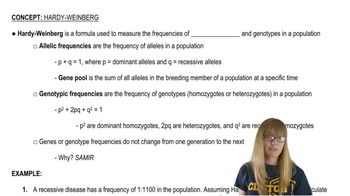
A theoretical framework for predicting allele and genotype frequencies in a population under idealized conditions.
Allele Frequency
The proportion of a specific genetic variant among all gene copies in a population at a given time.
Genotype Frequency
The proportion of individuals in a population with a particular genetic makeup at a specific locus.
p + q = 1
A formula expressing that the sum of dominant and recessive allele frequencies equals unity in a population.
p^2 + 2pq + q^2 = 1
An equation representing the expected frequencies of homozygous dominant, heterozygous, and homozygous recessive genotypes.
Dominant Allele
A genetic variant represented by 'p' that masks the effect of another variant at the same locus.
Recessive Allele
A genetic variant represented by 'q' whose effect is only seen when two copies are present.
Homozygous Dominant
A genotype consisting of two copies of the dominant allele, calculated as p squared in the formula.
Homozygous Recessive
A genotype with two copies of the recessive allele, represented as q squared and often linked to recessive traits.
Heterozygote
An individual with one dominant and one recessive allele, represented by 2pq in the Hardy Weinberg equation.
Gene Pool
The complete set of alleles present in the breeding members of a population at a specific time.
No Selection
An assumption where all genetic variants have equal chances of being passed to the next generation.
No Mutation
An assumption that no new genetic variants arise, ensuring allele frequencies remain unchanged.
No Migration
An assumption that individuals neither enter nor leave the population, keeping gene flow constant.
Random Mating
An assumption that mate choice is not influenced by genetic makeup, ensuring equal pairing probability.
 BackBack
 13:04
13:04