Back

Mapping Overview definitions

Control buttons has been changed to "navigation" mode.
1/14
  • Genetic Mapping

    Process for determining gene positions on a chromosome, using recombination frequencies to estimate distances.
  • Linked Genes

    Genes located on the same chromosome, typically inherited together due to their physical proximity.
  • Chromosome

    Structure composed of DNA and proteins, serving as the unit of inheritance during cell division.
  • Independent Assortment

    Principle stating that genes on different chromosomes segregate independently during meiosis.
  • Complete Linkage

    Situation where genes are always inherited together, showing no recombination between them.
  • Incomplete Linkage

    Condition where genes on the same chromosome may be separated due to crossing over.
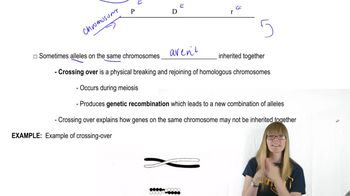
  • Crossing Over

    Physical exchange of chromosome segments between homologous chromosomes during meiosis, creating new allele combinations.
  • Genetic Recombination

    Formation of new allele combinations in offspring due to exchange of genetic material during meiosis.
  • Homologous Chromosomes

    Pair of chromosomes with the same genes, one inherited from each parent, that can exchange segments during meiosis.
  • Test Cross

    Breeding experiment involving a homozygous recessive individual to reveal the genotype of another organism.
  • F2 Population

    Generation resulting from crossing two F1 individuals, often used to observe inheritance patterns.
  • Linkage Group

    Set of genes located on the same chromosome and typically inherited together.
  • Map Unit

    Arbitrary measurement representing the frequency of recombination between genes, not tied to physical distance.
  • Recombination Frequency

    Proportion of offspring with new allele combinations, used to estimate genetic distances between genes.