Skip to main content
Genetics
My Course
Learn
Exam Prep
AI Tutor
Study Guides
Textbook Solutions
Flashcards
Explore
Try the app
My Course
Learn
Exam Prep
AI Tutor
Study Guides
Textbook Solutions
Flashcards
Explore
Try the app
Back
Methods for Analyzing DNA definitions
You can tap to flip the card.
Genomic Library
You can tap to flip the card.
👆
Genomic Library
A collection of bacterial clones containing fragments of an organism’s entire DNA, including coding and non-coding regions.
Track progress
Control buttons has been changed to "navigation" mode.
1/15
Related flashcards
Related practice
Recommended videos
Methods for Analyzing DNA quiz #1
Methods for Analyzing DNA
40 Terms
Methods for Analyzing DNA quiz #2
Methods for Analyzing DNA
12 Terms
Methods for Analyzing DNA
18. Molecular Genetic Tools
7 problems
Topic
Kylia
Genetic Cloning
18. Molecular Genetic Tools
7 problems
Topic
Kylia
18. Molecular Genetic Tools
2 topics
6 problems
Chapter
Kylia
Guided course
07:40
Methods for Analyzing DNA and RNA
1550
views
14
rank
1
comments
Terms in this set (15)
Hide definitions
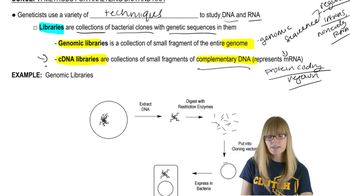
Genomic Library
A collection of bacterial clones containing fragments of an organism’s entire DNA, including coding and non-coding regions.
cDNA Library
A set of bacterial clones with DNA sequences reverse transcribed from mRNA, representing only protein-coding genes.
Bacterial Clone
A population of bacteria all carrying the same DNA fragment, used to amplify and study specific genetic sequences.
Restriction Enzyme
A protein that cuts DNA at specific sequences, generating fragments for cloning or analysis.
Cloning Vector
A DNA molecule, such as a plasmid, used to carry foreign DNA into a host cell for replication.
Southern Blot
A technique for separating and detecting specific DNA sequences by transferring them from a gel to a membrane.
Northern Blot
A method for separating and visualizing RNA sequences by transferring them from a gel to a membrane.
Agar
A jelly-like substance used to form gels for separating DNA or RNA fragments by size during electrophoresis.
Probe
A labeled molecule that binds to a specific DNA or RNA sequence on a membrane, enabling detection.
Membrane
A solid support onto which nucleic acids are transferred from a gel for further analysis.
Gene Expression
The process reflected in cDNA libraries, showing which protein-coding genes are active at a given time.
Non-coding Region
A segment of DNA that does not encode proteins, including regulatory elements and introns.
Fragment
A piece of DNA generated by restriction enzymes, used for cloning or analysis in libraries.
Ladder
A set of DNA fragments of known sizes run on a gel to estimate the size of sample fragments.
Electrophoresis
A technique where DNA or RNA moves through a gel under an electric field, separating by size and charge.
 BackBack
 07:40
07:40