Skip to main content
Genetics
My Course
Learn
Exam Prep
AI Tutor
Study Guides
Textbook Solutions
Flashcards
Explore
Try the app
My Course
Learn
Exam Prep
AI Tutor
Study Guides
Textbook Solutions
Flashcards
Explore
Try the app
Back
Types of Mutations definitions
You can tap to flip the card.
Spontaneous Mutation
You can tap to flip the card.
👆
Spontaneous Mutation
Originates from random errors during DNA replication, not influenced by external factors or agents.
Track progress
Control buttons has been changed to "navigation" mode.
1/30
Related flashcards
Related practice
Recommended videos
Types of Mutations quiz #1
Types of Mutations
40 Terms
Types of Mutations quiz #2
Types of Mutations
29 Terms
Types of Mutations
17. Mutation, Repair, and Recombination
7 problems
Topic
Kylia
Spontaneous Mutations
17. Mutation, Repair, and Recombination
4 problems
Topic
Kylia
17. Mutation, Repair, and Recombination
4 topics
10 problems
Chapter
Nicole
Guided course
03:49
Base Distortions
2055
views
23
rank
2
comments
Guided course
09:49
Point Mutations
2780
views
47
rank
Guided course
10:48
Mutations and Phenotypes
1977
views
27
rank
Terms in this set (30)
Hide definitions
Spontaneous Mutation
Originates from random errors during DNA replication, not influenced by external factors or agents.
Induced Mutation
Results from exposure to external agents like UV radiation or chemicals, often used in laboratory studies.
Somatic Cell Mutation
Occurs in non-reproductive cells, affecting only the individual and not passed to offspring.
Germ Cell Mutation
Arises in reproductive cells, enabling transmission to future generations and potentially impacting many.
Point Mutation
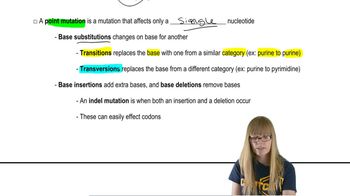
Involves alteration of a single nucleotide, which can lead to various effects on protein coding.
Transition
A base substitution where a purine replaces a purine or a pyrimidine replaces a pyrimidine.
Transversion
A base substitution where a purine is swapped with a pyrimidine or vice versa, altering base pairing.
Insertion
Addition of one or more nucleotides into a DNA sequence, potentially shifting the reading frame.
Deletion
Removal of one or more nucleotides from a DNA sequence, which can disrupt codon alignment.
Indel
A mutation involving both insertion and deletion events, possibly altering gene length and function.
Silent Mutation
A nucleotide change that does not alter the encoded amino acid, leaving protein function unaffected.
Missense Mutation
A nucleotide change that results in a different amino acid, possibly altering protein properties.
Nonsense Mutation
A nucleotide change that introduces a premature stop codon, truncating the protein product.
Frameshift Mutation
An insertion or deletion that alters the reading frame, drastically changing downstream amino acids.
Base Distortion
Structural alteration of DNA bases, often from chemical changes, disrupting normal base pairing.
Depurination
Loss of a purine base from DNA, creating an apurinic site and increasing mutation risk.
Deamination
Removal of an amino group from a base, converting cytosine to uracil and altering base pairing.
Oxidative Damage
DNA alteration caused by reactive oxygen species, leading to base modifications and mutations.
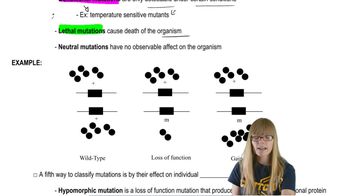
Loss of Function Mutation
Reduces or eliminates protein activity, potentially resulting in a nonfunctional gene product.
Gain of Function Mutation
Enhances or creates new protein activity, sometimes leading to novel or excessive function.
Null Mutation
Completely abolishes protein function, resulting in zero activity from the affected gene.
Conditional Mutant
Displays a mutant phenotype only under specific environmental conditions, such as temperature.
Lethal Mutation
Causes organismal death, often preventing development or survival beyond early stages.
Neutral Mutation
Has no observable effect on phenotype, often occurring in noncoding regions or as silent changes.
Hypomorphic Mutation
Reduces but does not eliminate gene function, resulting in partial protein activity.
Hypermorphic Mutation
Increases gene function, producing more or more active protein than normal.
Neomorphic Mutation
Confers a novel function or phenotype not previously observed for the gene.
Suppressor Mutation
Counteracts the effect of another mutation, restoring or improving the original phenotype.
Intragenic Suppressor
Occurs within the same gene as the original mutation, mitigating its effects.
Intergenic Suppressor
Arises in a different gene, compensating for or blocking the impact of another mutation.
 BackBack


 03:49
03:49