
Pearson+ LogoPearson+ Logo
Ch. 1 - The Molecular Basis of Heredity, Variation, and Evolution
Sanders - Genetic Analysis: An Integrated Approach 3rd Edition
Sanders3rd EditionGenetic Analysis: An Integrated ApproachISBN: 9780135564172Not the one you use?Change textbook
Chapter 1, Problem 33

It is common to study the biology and genetics of bacteria, yeast, fruit flies, and mice to understand biological and genetic processes in humans. Why do you think this is the case?

Verified step by step guidance
1
insert step 1> Understand that model organisms like bacteria, yeast, fruit flies, and mice are used in genetic research because they share many biological and genetic similarities with humans.
insert step 2> Recognize that these organisms have simpler systems, making it easier to study complex biological processes.
insert step 3> Note that these organisms have short life cycles and reproduce quickly, allowing for the observation of multiple generations in a short period.
insert step 4> Consider that these organisms are often easier to manipulate genetically, enabling researchers to study the effects of specific genes.
insert step 5> Acknowledge that findings in these model organisms can often be extrapolated to understand human biology and disease, due to the conservation of many genetic pathways.

Verified video answer for a similar problem:

This video solution was recommended by our tutors as helpful for the problem above.
Video duration:
1m
Was this helpful?

Key Concepts

Here are the essential concepts you must grasp in order to answer the question correctly.

Model Organisms

Model organisms are species that are extensively studied to understand biological processes due to their simpler systems, short life cycles, and genetic similarities to humans. Examples include fruit flies (Drosophila melanogaster) and mice (Mus musculus), which allow researchers to investigate genetic functions and disease mechanisms that can be extrapolated to human biology.
Recommended video:
Guided course
09:12
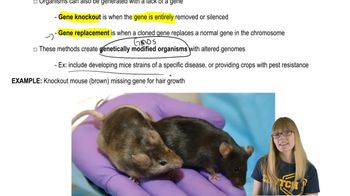
Transgenic Organisms and Gene Therapy

Genetic Homology

Genetic homology refers to the similarity in DNA sequences between different species, indicating a common ancestry. This concept is crucial in genetics as it allows scientists to use findings from model organisms to infer functions of human genes, facilitating the understanding of genetic diseases and potential treatments.
Recommended video:
Guided course
03:45
Descriptive Genetics

Experimental Manipulation

Experimental manipulation involves altering the genetic makeup of model organisms to observe the effects on biological processes. Techniques such as CRISPR gene editing enable researchers to create specific mutations, helping to elucidate gene function and the underlying mechanisms of diseases, which can be relevant to human health.
Recommended video:
Guided course
09:03
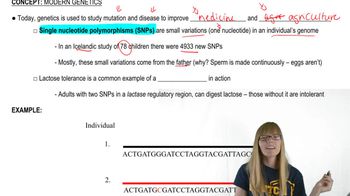
Modern Genetics
Related Practice
Textbook Question

In certain cases, genetic testing can identify mutant alleles that greatly increase a person's chance of developing a disease such as breast cancer or colon cancer. Between 50 and 70% of people with these particular mutations will develop cancer, but the rest will not. Imagine you are either a 30-year-old woman with a family history of breast cancer or a 30-year-old man with a family history of colon cancer (choose one). Each person can undergo genetic testing to identify a mutation that greatly increases susceptibility to the disease. Putting yourself in the place of the person you have chosen, provide answers to the following questions.

If you were the spouse or partner of the person you have selected, would you encourage or would you discourage the person from having the genetic test? Why?

529
views
Textbook Question

In certain cases, genetic testing can identify mutant alleles that greatly increase a person's chance of developing a disease such as breast cancer or colon cancer. Between 50 and 70% of people with these particular mutations will develop cancer, but the rest will not. Imagine you are either a 30-year-old woman with a family history of breast cancer or a 30-year-old man with a family history of colon cancer (choose one). Each person can undergo genetic testing to identify a mutation that greatly increases susceptibility to the disease. Putting yourself in the place of the person you have chosen, provide answers to the following questions.

If this person that you have selected were you, do you think you would have the genetic test or not? Can you explain the reasons for your answer?

539
views
Textbook Question

What information presented in this chapter and what information familiar to you from previous general biology courses is consistent with all life having a common origin?

740
views