Pearson+ LogoPearson+ Logo
Ch. 10 - Eukaryotic Chromosome Abnormalities and Molecular Organization
Sanders - Genetic Analysis: An Integrated Approach 3rd Edition
Sanders3rd EditionGenetic Analysis: An Integrated ApproachISBN: 9780135564172Not the one you use?Change textbook
Chapter 10, Problem 32c

A healthy couple with a history of three previous spontaneous abortions has just had a child with cri-du-chat syndrome, a disorder caused by a terminal deletion of chromosome 5. Their physician orders karyotype analysis of both parents and of the child. The karyotype results for chromosomes 5 and 12 are shown here. Why does this parent have a normal phenotype?

Verified step by step guidance
1
Understand the genetic basis of cri-du-chat syndrome: It is caused by a terminal deletion on the short arm of chromosome 5 (5p). This deletion leads to the loss of specific genes, resulting in the clinical features of the syndrome.
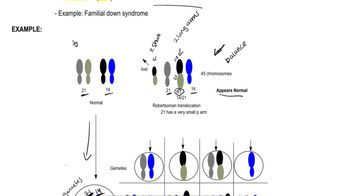
Review the concept of balanced chromosomal rearrangements: A parent may have a chromosomal rearrangement, such as a translocation, that is balanced. In a balanced rearrangement, no genetic material is lost or gained, so the individual typically has a normal phenotype.
Examine the karyotype results: Analyze the karyotype data provided for chromosomes 5 and 12. Look for evidence of a balanced translocation involving these chromosomes, which could explain why the parent has a normal phenotype despite the potential for genetic abnormalities.
Consider the inheritance mechanism: If the parent has a balanced translocation, they can pass on an unbalanced chromosomal arrangement to their offspring. This unbalanced arrangement could result in the terminal deletion on chromosome 5 observed in the child with cri-du-chat syndrome.
Conclude why the parent has a normal phenotype: The parent’s balanced translocation does not disrupt the function of their genes, allowing them to have a normal phenotype. However, the unbalanced chromosomal inheritance in the child leads to the clinical features of cri-du-chat syndrome.

Verified video answer for a similar problem:

This video solution was recommended by our tutors as helpful for the problem above.
Video duration:
2m
Was this helpful?

Key Concepts

Here are the essential concepts you must grasp in order to answer the question correctly.

Cri-du-chat Syndrome

Cri-du-chat syndrome is a genetic disorder caused by a deletion of a portion of chromosome 5, specifically at the 5p15.2 region. This deletion leads to various developmental issues, including distinctive facial features, intellectual disability, and a high-pitched cry resembling a cat's meow. Understanding this syndrome is crucial for analyzing the genetic implications for the child and the parents.
Recommended video:
Guided course
09:31
Robertsonian Translocations

Karyotype Analysis

Karyotype analysis is a laboratory technique used to visualize an individual's chromosomes, allowing for the identification of chromosomal abnormalities such as deletions, duplications, or translocations. In this case, karyotyping can help determine whether the parents carry any chromosomal anomalies that could explain the child's condition or their own normal phenotypes despite a history of miscarriages.
Recommended video:
Guided course
02:48
Chi Square Analysis

Phenotype vs. Genotype

The phenotype refers to the observable characteristics or traits of an individual, while the genotype is the underlying genetic makeup. A parent may have a normal phenotype despite carrying a genetic mutation if the mutation is recessive or if they possess a normal allele that compensates for the abnormal one. This distinction is essential for understanding why one parent appears normal even if there are genetic concerns in the family history.
Recommended video:
Guided course
07:52
Gamete Genotypes
Related Practice
Textbook Question

For the following crosses, determine as accurately as possible the genotypes of each parent, the parent in whom nondisjunction occurs, and whether nondisjunction takes place in the first or second meiotic division. Both color blindness and hemophilia, a blood-clotting disorder, are X-linked recessive traits. In each case, assume the parents have normal karyotypes.

A man who is color blind and has hemophilia and a woman who is wild type have a daughter with triple X syndrome (XXX) who has hemophilia and normal color vision.

529
views
Textbook Question

A healthy couple with a history of three previous spontaneous abortions has just had a child with cri-du-chat syndrome, a disorder caused by a terminal deletion of chromosome 5. Their physician orders karyotype analysis of both parents and of the child. The karyotype results for chromosomes 5 and 12 are shown here. Are the chromosomes in the child consistent with those expected in a case of cri-du-chat syndrome? Explain your reasoning.

676
views
Textbook Question

A healthy couple with a history of three previous spontaneous abortions has just had a child with cri-du-chat syndrome, a disorder caused by a terminal deletion of chromosome 5. Their physician orders karyotype analysis of both parents and of the child. The karyotype results for chromosomes 5 and 12 are shown here. Which parent has an abnormal karyotype? How can you tell? What is the nature of the abnormality?

405
views
Textbook Question

A healthy couple with a history of three previous spontaneous abortions has just had a child with cri-du-chat syndrome, a disorder caused by a terminal deletion of chromosome 5. Their physician orders karyotype analysis of both parents and of the child. The karyotype results for chromosomes 5 and 12 are shown here. Diagram the pairing of the abnormal chromosomes.

368
views
Textbook Question

A healthy couple with a history of three previous spontaneous abortions has just had a child with cri-du-chat syndrome, a disorder caused by a terminal deletion of chromosome 5. Their physician orders karyotype analysis of both parents and of the child. The karyotype results for chromosomes 5 and 12 are shown here. What segregation pattern occurred to produce the gamete involved in fertilization of the child with cri-du-chat syndrome?

379
views
Textbook Question

A healthy couple with a history of three previous spontaneous abortions has just had a child with cri-du-chat syndrome, a disorder caused by a terminal deletion of chromosome 5. Their physician orders karyotype analysis of both parents and of the child. The karyotype results for chromosomes 5 and 12 are shown here. What is the approximate probability that the next child of this couple will have cri-du-chat syndrome?

374
views