Textbook Question
In the lac operon, what are the likely effects on operon gene transcription of the mutations described in a–e?
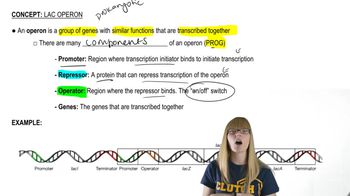
Mutation of consensus sequence in the lac promoter
876
views

 Sanders 3rd EditionCh. 12 - Regulation of Gene Expression in Bacteria and BacteriophageProblem 16d
 Verified step by step guidance
 04:27
04:27
 02:33
02:33 03:38
03:38In the lac operon, what are the likely effects on operon gene transcription of the mutations described in a–e?
Mutation of consensus sequence in the lac promoter
In the lac operon, what are the likely effects on operon gene transcription of the mutations described in a–e?
Mutation of the repressor binding site on the operator sequence
Identify which of the following lac operon haploid genotypes transcribe operon genes inducibly and which transcribe genes constitutively. Indicate whether the strain is lac⁺ (able to grow on lactose-only medium) or lac⁻ (cannot grow on lactose medium).
I⁺ P⁺ O⁺ Z⁺ Y⁻
In the lac operon, what are the likely effects on operon gene transcription of the mutations described in a–e?
Mutation of the lacI gene affecting the allosteric site of the protein
Identify which of the following lac operon haploid genotypes transcribe operon genes inducibly and which transcribe genes constitutively. Indicate whether the strain is lac⁺ (able to grow on lactose-only medium) or lac⁻ (cannot grow on lactose medium).
I⁺ P⁺ Oᶜ Z⁻ Y⁺
In the lac operon, what are the likely effects on operon gene transcription of the mutations described in a–e?
Mutation of the CAP binding site of the lac promoter