Pearson+ LogoPearson+ Logo
Ch. 13 - Regulation of Gene Expression in Eukaryotes
Sanders - Genetic Analysis: An Integrated Approach 3rd Edition
Sanders3rd EditionGenetic Analysis: An Integrated ApproachISBN: 9780135564172Not the one you use?Change textbook
Chapter 13, Problem 20b

A muscle enzyme called ME1 is produced by transcription and translation of the ME1 gene in several muscles during mouse development, including heart muscle, in a highly regulated manner. Production of ME1 appears to be turned on and turned off at different times during development. To test the possible role of enhancers and silencers in ME1 transcription, a biologist creates a recombinant genetic system that fuses the ME1 promoter, along with DNA that is upstream of the promoter, to the bacterial lacZ (β-galactosidase) gene. The lacZ gene is chosen for the ease and simplicity of assaying production of the encoded enzyme. The diagram shows bars that indicate the extent of six deletions the biologist makes to the ME1 promoter and upstream sequences. The blue deletion labeled D is within the promoter whereas the gray bars span potential enhancer/silencer modules. The table displays the percentage of β-galactosidase activity in each deletion mutant in comparison with the recombinant gene system without any deletions.


Diagram showing ME1 gene deletions and lacZ activity percentages for gene regulation study.


Why does deletion D effectively eliminate transcription of lacZ?

Verified step by step guidance
1
Analyze the diagram and table provided. The diagram shows the ME1 gene structure, including the upstream region, promoter, and lacZ gene. The deletions (A-F) are marked as gray bars, with deletion D specifically within the promoter region. The table shows the percentage of lacZ activity for each deletion mutant compared to the control (no deletion). Deletion D results in <1% lacZ activity.
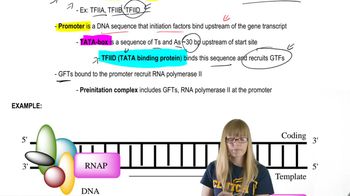
Understand the role of the promoter in transcription. The promoter is a DNA sequence that serves as the binding site for RNA polymerase and other transcription factors, initiating transcription of the downstream gene. If the promoter is disrupted, transcription cannot occur effectively.
Interpret the data for deletion D. Since deletion D is within the promoter region and results in <1% lacZ activity, this suggests that the deleted region is critical for the binding of RNA polymerase or transcription factors necessary for initiating transcription.
Compare deletion D to other deletions. Deletions A, B, and C, which are upstream of the promoter, do not significantly affect lacZ activity, indicating that these regions may not contain essential elements for transcription initiation. Deletion E increases lacZ activity, suggesting it may remove a silencer element, while deletion F reduces activity, possibly removing an enhancer element.
Conclude that deletion D effectively eliminates transcription of lacZ because it disrupts the promoter region, which is essential for RNA polymerase binding and transcription initiation. Without a functional promoter, the lacZ gene cannot be transcribed.

Verified video answer for a similar problem:

This video solution was recommended by our tutors as helpful for the problem above.
Video duration:
1m
Was this helpful?

Key Concepts

Here are the essential concepts you must grasp in order to answer the question correctly.

Gene Regulation

Gene regulation refers to the mechanisms that control the expression of genes, determining when and how much of a gene product is produced. This process is crucial for cellular differentiation and response to environmental changes. In the context of the ME1 gene, regulation involves enhancers and silencers that can activate or repress transcription, influencing the production of the ME1 enzyme in muscle tissues.
Recommended video:
Guided course
09:22
Review of Regulation

Promoter Function

The promoter is a specific DNA sequence located upstream of a gene that serves as the binding site for RNA polymerase and transcription factors. It is essential for initiating transcription. Deletion D, located within the promoter region of the ME1 gene, likely disrupts the necessary interactions for transcription initiation, leading to the observed elimination of lacZ expression.
Recommended video:
Guided course
08:26
Functional Genomics

Enhancers and Silencers

Enhancers and silencers are regulatory DNA sequences that can increase or decrease gene transcription, respectively. Enhancers can be located far from the promoter and interact with it through DNA looping, while silencers inhibit transcription. The experiment's design, which includes deletions in potential enhancer/silencer regions, helps to elucidate their roles in regulating ME1 transcription and the resulting lacZ activity.
Recommended video:
Guided course
09:16
Eukaryotic Transcription
Related Practice
Textbook Question

The UG4 gene is expressed in stem tissue and leaf tissue of the plant Arabidopsis thaliana. To study mechanisms regulating UG4 expression, six small deletions of DNA sequence upstream of the gene-coding sequence are made. The locations of deletions and their effect on UG4 expression are shown here. Why does deletion E lower expression of UG4 in leaf tissue but not in stem tissue?

461
views
Textbook Question

Diagram and explain how the inducibility of a gene—for instance in response to an environmental cue—could be mediated by an activator. Then show how it could be mediated by a repressor.

667
views
Textbook Question

A muscle enzyme called ME1 is produced by transcription and translation of the ME1 gene in several muscles during mouse development, including heart muscle, in a highly regulated manner. Production of ME1 appears to be turned on and turned off at different times during development. To test the possible role of enhancers and silencers in ME1 transcription, a biologist creates a recombinant genetic system that fuses the ME1 promoter, along with DNA that is upstream of the promoter, to the bacterial lacZ (β-galactosidase) gene. The lacZ gene is chosen for the ease and simplicity of assaying production of the encoded enzyme. The diagram shows bars that indicate the extent of six deletions the biologist makes to the ME1 promoter and upstream sequences. The blue deletion labeled D is within the promoter whereas the gray bars span potential enhancer/silencer modules. The table displays the percentage of β-galactosidase activity in each deletion mutant in comparison with the recombinant gene system without any deletions.


Does this information indicate the presence of enhancer and/or silencer sequences in the ME1 upstream sequence? If so, where is/are the sequences located? 

518
views
Textbook Question

A muscle enzyme called ME1 is produced by transcription and translation of the ME1 gene in several muscles during mouse development, including heart muscle, in a highly regulated manner. Production of ME1 appears to be turned on and turned off at different times during development. To test the possible role of enhancers and silencers in ME1 transcription, a biologist creates a recombinant genetic system that fuses the ME1 promoter, along with DNA that is upstream of the promoter, to the bacterial lacZ (β-galactosidase) gene. The lacZ gene is chosen for the ease and simplicity of assaying production of the encoded enzyme. The diagram shows bars that indicate the extent of six deletions the biologist makes to the ME1 promoter and upstream sequences. The blue deletion labeled D is within the promoter whereas the gray bars span potential enhancer/silencer modules. The table displays the percentage of β-galactosidase activity in each deletion mutant in comparison with the recombinant gene system without any deletions.


Given the information available from deletion analysis, can you give a molecular explanation for the observation that ME1 expression appears to turn on and turn off at various times during normal mouse development?

569
views
Textbook Question

Using the components in the accompanying diagram, design regulatory modules (i.e., enhancer/silencer modules) required for 'your' gene to be expressed only in differentiating (early) and differentiated (late) liver cells. Answer the three questions presented below by describing the roles that activators, enhancers, repressors, silencers, pioneer factors, insulators, chromatin remodeling complexes, and chromatin readers, writers, and erasers will play in the regulation of expression of your gene, that is, what factors will bind and be active in each case? Specify which transcription factors need to be pioneer factors. How will the gene be activated in the proper cell type?

518
views
Textbook Question

Using the components in the accompanying diagram, design regulatory modules (i.e., enhancer/silencer modules) required for 'your' gene to be expressed only in differentiating (early) and differentiated (late) liver cells. Answer the three questions presented below by describing the roles that activators, enhancers, repressors, silencers, pioneer factors, insulators, chromatin remodeling complexes, and chromatin readers, writers, and erasers will play in the regulation of expression of your gene, that is, what factors will bind and be active in each case? Specify which transcription factors need to be pioneer factors. How will its expression be maintained?

423
views