Pearson+ LogoPearson+ Logo
Ch. 13 - Regulation of Gene Expression in Eukaryotes
Sanders - Genetic Analysis: An Integrated Approach 3rd Edition
Sanders3rd EditionGenetic Analysis: An Integrated ApproachISBN: 9780135564172Not the one you use?Change textbook
Chapter 13, Problem 1b

Devoting a few sentences to each, describe the following structures or complexes and their effects on eukaryotic gene expression:
Enhancer

Verified step by step guidance
1
An enhancer is a short region of DNA that can be located upstream, downstream, or even within a gene. It is not necessarily close to the gene it regulates, as it can act over long distances.
Enhancers contain specific DNA sequences that serve as binding sites for transcription factors. These transcription factors are proteins that help regulate the transcription of the associated gene.
When transcription factors bind to an enhancer, they interact with the basal transcription machinery at the gene's promoter, often through the help of mediator complexes. This interaction increases the efficiency of transcription initiation.
Enhancers can influence the rate of transcription by looping the DNA to bring the enhancer region into close proximity with the promoter region of the gene, facilitating the assembly of the transcriptional machinery.
The activity of enhancers is highly specific, as they often work in a tissue-specific or developmental stage-specific manner, ensuring that genes are expressed at the right time and in the right cells.

Verified video answer for a similar problem:

This video solution was recommended by our tutors as helpful for the problem above.
Video duration:
2m
Was this helpful?

Key Concepts

Here are the essential concepts you must grasp in order to answer the question correctly.

Enhancers

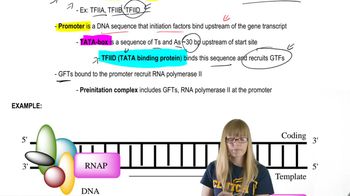
Enhancers are regulatory DNA sequences that can significantly increase the transcription of specific genes. They are located distally from the promoter regions and can function in an orientation-independent manner. Enhancers bind transcription factors, which facilitate the assembly of the transcriptional machinery at the promoter, thereby enhancing gene expression. Their activity can be influenced by various signals, allowing for precise control of gene expression in response to cellular conditions.
Recommended video:
Guided course
09:16
Eukaryotic Transcription

Transcription Factors

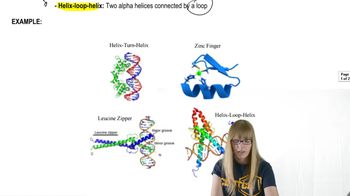
Transcription factors are proteins that bind to specific DNA sequences, such as enhancers and promoters, to regulate gene expression. They can act as activators or repressors, influencing the recruitment of RNA polymerase and other components necessary for transcription. The interaction between transcription factors and enhancers is crucial for the precise timing and level of gene expression, allowing cells to respond to developmental cues and environmental changes.
Recommended video:
Guided course
09:16
Eukaryotic Transcription

Eukaryotic Gene Expression Regulation

Eukaryotic gene expression regulation involves multiple layers of control, including chromatin structure, transcription initiation, and post-transcriptional modifications. Enhancers play a vital role in this regulation by interacting with promoters to modulate transcription levels. This complex regulation allows for the fine-tuning of gene expression, enabling cells to adapt to various physiological conditions and developmental stages. Understanding these mechanisms is essential for comprehending how genes are expressed in eukaryotic organisms.
Recommended video:
Guided course
09:22
Review of Regulation